BSW Temple, TX · Night-Shift Housing Guide
Where Night-Shift Nurses Should Live Near Baylor Scott & White
A 7pm–7am schedule doesn’t just change your commute — it changes what a good house even is. You’re choosing for daytime sleep and two drives a day, one of them home at 7am in winter darkness. Here’s how to pick a Temple neighborhood that actually lets you rest.
Pick a west-side neighborhood that is off the BNSF rail corridor, on a short symmetric commute to BSW, and built after 2015 so it can actually black out and quiet down for daytime sleep. Canyon Creek (4–5 minutes), Western Hills (8), and Wildflower Country (9–10) rank highest on the combination that matters for nights: low daytime noise, a fast 7am drive home, and newer construction. Avoid the South Temple blocks near the at-grade crossings on South Main, South 8th, and South 5th — federal rules force 15–20-second train-horn blasts there through the exact hours you’re trying to sleep. Travel nurses on 13-week contracts should rent furnished ($1,550–$1,895, utilities included); staff RNs staying two-plus years should buy in a quiet west-side zone.
Night-Shift Housing Is a Different Problem — Here’s the One Thing to Get Right
Every generic “best neighborhoods” guide optimizes for the daytime worker: proximity to the hospital, schools, shopping. For a nurse on a 7pm–7am rotation, two of those barely matter and one thing dominates that no one mentions: can you sleep here between 9am and 5pm?
That reframes three decisions. First, your commute counts in both directions — the 7am drive home, when you’re fighting microsleep after twelve hours, matters as much as the drive in. Second, daytime noise is the enemy, not nighttime noise; a neighborhood that’s silent at midnight can be a construction-and-train zone at 1pm. Third, the building itself is a sleep spec: blackout capability, wall thickness, and whether there’s someone walking around above your bedroom while you’re trying to rest. Get those right and nights are sustainable. Get them wrong and you’ll spend a contract exhausted.
The 7 AM Drive Home: Why Your Commute Matters in Both Directions
Real drive times from BSW Medical Center to the west-side neighborhoods, in light Temple traffic (roughly symmetric both directions):
| Neighborhood | Drive to/from BSW | Night-shift read |
|---|---|---|
| Canyon Creek | 4–5 min | Shortest crash-risk exposure; quiet, west of the rail yard |
| Western Hills | 8 min | Value pick; no highway dependency, quiet daytime |
| Wildflower Country | 9–10 min | Newer stock, still short and symmetric |
| Sage Meadows | 13 min | Newer construction; longer but low-noise |
| The Grove at Lakewood Ranch | 16 min | Farthest of the quiet options; weigh the 7am fatigue cost |
The reason to minimize the home leg specifically: microsleep risk peaks at the end of a night shift, and the drive home happens in near-darkness through the winter. A four-minute Canyon Creek drive versus a sixteen-minute Grove drive isn’t a small difference at 7:15am on your fourth night in a row.
The BNSF Rail Corridor: Which Temple Neighborhoods Eat Train Horns All Day
Temple exists because of the railroad, and it’s still a major BNSF junction where three subdivisions converge. Depending on the segment, 15 to 100 trains a day move through town. Federal Railroad Administration rules require the engineer to sound the horn for a minimum of 15–20 seconds before every public at-grade crossing — and those blasts land squarely in a night-shift worker’s 9am–5pm sleep window.
The high-impact at-grade crossings near BSW are on South Main Street, South 8th Street, and South 5th Street. Housing in direct proximity to these — much of the older South Temple stock and some hospital-district apartments — gets intermittent high-decibel horn transmission through the entire daylight period, even a fair distance from the crossing itself. The physical shelter of the west-side neighborhoods (Canyon Creek, Western Hills, Wildflower) from the rail corridor is a real, measurable advantage for a daytime sleeper.
The Noise-Ordinance Trap No One Tells Night-Shift Nurses About
Here’s the honest legal reality most guides get wrong: Temple’s noise ordinance is Chapter 24 (not the “Chapter 18” that turns up in searches — that’s business licensing). And its quiet-hours protection runs only from roughly 10:00pm to 7:00am.
Read that again as a night-shift worker: the hours the ordinance protects are the exact hours you’re at work. The hours you’re home sleeping — 9am to 5pm — have no quiet-hours protection at all. A neighbor’s 2pm lawn crew, an afternoon construction site, a barking dog at noon: you have essentially no recourse. There is a Section 24-7 that prohibits excessive noise near a hospital, but it protects the medical center itself and ends at the property line — it does nothing for your house three blocks away. The takeaway is blunt: you cannot rely on the city to protect your sleep. You have to buy or rent your way into quiet.
Build Year Is a Sleep Spec: 1970s vs Post-2015 Construction
Treat the build year as an acoustic and blackout rating. Older near-track builds — much of the 1970s South Temple stock — pair thin walls and single-pane windows with floor plans that were never designed to black out a bedroom at noon. Post-2015 west-side subdivisions (the Wyndham Hill area, Sage Meadows, Wildflower) were built with better glazing, tighter envelopes, and layouts that make blackout curtains actually work.
This isn’t a luxury preference for a night nurse — it’s the difference between a bedroom that hits true darkness and quiet at 1pm and one that doesn’t. If you’re touring an older home or apartment, check the windows and the wall the bedroom shares with the outside world before you fall for the kitchen.
Apartment vs. House: Picking a Unit That Actually Lets You Sleep
Below the neighborhood level, the specific unit matters more for a night worker than for anyone else. The single most useful rule: a single-story unit eliminates vertical impact noise — the footsteps of an upstairs neighbor going about their normal daytime life. That footfall thud is precisely the sound a white-noise machine cannot mask, because it’s felt as much as heard. Single-story rentals (bungalow-style complexes like the Virtu on Azalea) or a house solve it outright; if you must be in a multi-story building, take a top-floor corner unit.
- Single-story or top floor — no one walking above your bedroom at midday.
- Bedroom on the interior/quiet side — away from the parking lot, the road, and any shared laundry.
- Real blackout capability — newer glazing plus room-darkening treatment, not just blinds.
- Preferred-employer programs — several complexes court medical staff. Villas on the Hill (2510 S 31st St) runs a preferred-employer program and sits on the well-lit 31st Street corridor, which minimizes the post-shift drive in the dark.
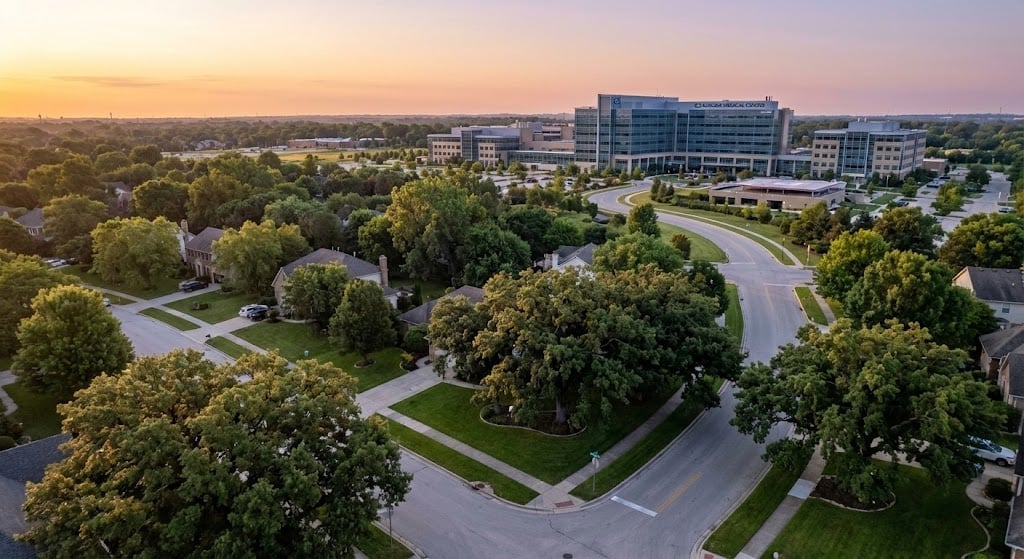
Best Temple Neighborhoods for Night-Shift Nurses (Ranked by Noise + Commute)
The tier list, weighing daytime quiet, real drive time both directions, and build era together rather than proximity alone:
| Tier | Neighborhood | Why |
|---|---|---|
| Best | Canyon Creek | 4–5 min, west of the rail yard, quiet, newer stock — the top night-shift pick |
| Best | Western Hills | 8 min, no MUD/PID, value pricing, quiet daytime — strong for renters and buyers |
| Strong | Wildflower Country | 9–10 min, newer construction, blackout-ready layouts |
| Strong | Wyndham Hill area / Sage Meadows | Post-2015 builds engineered to quiet and darken; 13-minute range |
| Avoid | South Temple near the tracks | South Main / 8th / 5th at-grade crossings = all-day horn blasts through your sleep window |
Commute detail by neighborhood is mapped on Neighborhoods Near BSW by Commute, and the full city picture is on Best Neighborhoods in Temple TX.
Rent or Buy? The Honest Split for Travel vs. Staff Nurses
The right move depends entirely on how long you’re here:
13-week / travel contracts → rent furnished (mid-term)
Don’t buy for a three-month assignment, and don’t sign a 12-month lease. Use furnished mid-term platforms — RotatingRoom, Furnished Finder, Apartments.com — which show live Temple sublets near BSW from roughly $650–$1,000/month for a room, and full furnished units from about $1,550–$1,895/month with utilities and Wi-Fi included. It’s the cleanest fit for a rotating schedule.
Staff RN staying 2+ years → buy in a quiet west-side zone
If you’re planting roots, Temple’s entry prices make buying rational, and night differentials stretch a nurse’s budget further than the base rate suggests (Temple RN pay averages about $39.25/hour). Target the quiet west-side neighborhoods above; if you also carry student debt or want a low-down-payment path, the same physician-adjacent lending landscape that serves BSW residents can help — see the rent-vs-buy breakdown and the Central Texas mortgage guide.
If you’re thinking of the other side of this — buying a Temple property specifically to rent to traveling nurses — that’s an investor play with its own math, covered separately on Travel Nurse Housing Investment in Temple.
What Furnished and Mid-Term Housing Actually Costs Near BSW
Real, recent numbers so you can budget honestly:
| Option | Typical cost | Notes |
|---|---|---|
| Unfurnished 3BR/2BA near BSW | $1,400–$1,900/mo | e.g. a 2007-built home ~9 minutes to BSW listed around $1,895 |
| Furnished mid-term unit (utilities + Wi-Fi in) | ~$1,550–$1,895/mo | e.g. a 2024 furnished 2BR cottage at ~$1,550; travel-nurse listings ~$1,895, 5 min out |
| Room / sublet (RotatingRoom, Furnished Finder) | $650–$1,000/mo | Cheapest for solo travelers on short contracts |
| Preferred-employer apartment (2BR) | ~$1,360–$2,129/mo | Medical-staff concessions; verify rail-corridor location first |
Prices move — treat these as ranges to plan around, and confirm current rates and any BSW-employee concession before you commit.
Get a Night-Shift Housing Shortlist
Tell me your schedule, your budget, and whether you’re on a travel contract or staying long-term. I’ll send back a shortlist scored for daytime quiet, the 7am drive home, and blackout-ready construction — plus the furnished options if you’re on assignment. No pitch, just the plan.
Prefer to talk? Call or text 254-718-4249 · dealswithdasch@gmail.com · Taylor Dasch, EG Realty, Temple TX
Frequently Asked Questions
What are the quietest neighborhoods near Baylor Scott & White for night-shift workers?
Canyon Creek, Western Hills, and Wildflower Country are the quietest close-in options — all west of the BNSF rail corridor, with short symmetric commutes (4–10 minutes) and newer construction that blacks out better for daytime sleep. Post-2015 subdivisions in the Wyndham Hill and Sage Meadows area also rank well. The zones to screen out are the older South Temple blocks near the at-grade crossings on South Main, South 8th, and South 5th.
Why is Temple, TX so loud near the hospital during the day?
Temple is a major BNSF railroad junction with 15–100 trains a day depending on the segment, and federal rules require 15–20-second horn blasts before every public at-grade crossing. The high-impact crossings sit on South Main, South 8th, and South 5th near BSW, so hospital-district and South Temple housing gets intermittent horn noise straight through the 9am–5pm hours a night-shift worker is trying to sleep.
Which Temple neighborhoods should BSW night-shift workers avoid?
Avoid housing in direct proximity to the at-grade rail crossings on South Main, South 8th, and South 5th Streets, and be cautious with 1970s-era stock that pairs thin walls and single-pane windows with layouts that don’t black out at midday. Some hospital-district apartments advertise a sub-5-minute commute but sit inside the rail corridor — verify the exact location before signing.
Does Temple, TX have railroad quiet zones?
The practical answer for a renter or buyer is to assume the horns will sound. Temple’s core is an active BNSF junction, and the FRA horn requirement applies at public at-grade crossings unless a formal quiet zone has been established and maintained. Rather than count on a quiet zone, choose housing physically off the corridor — the west-side neighborhoods are shielded from it.
How do travel nurses find temporary housing in Temple?
Furnished mid-term platforms are the standard route: RotatingRoom, Furnished Finder, and Apartments.com show live Temple listings near BSW, from about $650–$1,000/month for a room up to roughly $1,550–$1,895/month for a full furnished unit with utilities and Wi-Fi included. Facebook travel-nurse housing groups also carry active Temple listings. Prioritize a single-story or top-floor unit off the rail corridor.
How far is a reasonable commute for a night-shift nurse in Temple?
Aim for under ten minutes each way. Canyon Creek (4–5 min), Western Hills (8 min), and Wildflower Country (9–10 min) all clear that bar while staying quiet. The reason to keep it short is safety, not convenience — microsleep risk is highest on the 7am drive home, often in winter darkness, so a shorter home leg is a real hazard reduction.
How much do RNs make in Temple, Texas, and what housing does that support?
Registered nurse pay in Temple averages about $39.25 per hour, and night differentials push effective pay higher. That comfortably supports the $1,400–$1,900/month unfurnished range near BSW, and for staff nurses staying two-plus years it supports buying at Temple’s entry price points in the quiet west-side neighborhoods.