Travel Nurse Housing Investment in Temple, TX
Is Temple TX good for travel nurse housing investment?
Yes — but not because of travel nurses. The real thesis is Baylor Scott & White’s 47 residency and fellowship programs, which create a continuously rotating population of medical professionals needing furnished housing for 1–12 months. Travel nurses represent only 25% of the actual demand pool. The remaining 75% — rotating residents, fellows, visiting medical students, locum tenens physicians, and patient families at McLane Children’s Hospital — is the durable demand that makes this strategy viable. But the math only works in older, low-basis properties within 7 minutes of BSW, outside of HOA restrictions.
- BSW Temple operates 47 GME programs (21 residency + 26 fellowship) — the largest rotating tenant pool in Central Texas.
- 636-bed Level I Adult Trauma Center + McLane Children’s Hospital + Olin E. Teague VA Center within a 2-mile radius.
- Furnished Finder shows 56% average occupancy for Temple listings — conservative underwriting should model 60–65%.
- 30+ day leases bypass the combined 13% hotel occupancy tax (6% state + 7% city) under the Texas Permanent Resident Exemption.
- Canyon Creek / Hospital District properties at $140K–$350K provide the yield spread needed to absorb furnishing + operational costs.
- Net MTR yield at 75% occupancy (~$1,143/mo) falls below unfurnished LTR benchmarks ($1,400/mo) — occupancy rate IS the entire thesis.
Why “Travel Nurse Housing” Is the Wrong Frame
The myth: Travel nurse demand drives furnished housing investment near hospitals. Google “travel nurse housing investment” and you will find hundreds of blog posts telling you to buy a property near a hospital, furnish it from Wayfair, list it on Furnished Finder, and collect $2,500/month in passive income. Most of those articles were written between 2020 and 2022, when COVID-era travel nurse contracts were paying $5,000–$10,000/week and agencies were placing nurses in any available housing at almost any price.
The reality: Post-COVID travel nurse demand has normalized significantly. Contract rates have compressed 40–60% from their pandemic peaks. Agencies are more selective about housing stipends. And the “passive income” narrative was always fiction — furnished rentals are hospitality businesses with cleaning turns, utility management, guest communication, and furnishing depreciation that most spreadsheets conveniently ignore.
The real thesis: BSW Temple’s massive Graduate Medical Education ecosystem creates five distinct tenant types — not one. Travel nurses are roughly 25% of the addressable market. The other 75% — rotating medical residents, visiting students on clinical blocks, locum tenens physicians filling coverage gaps, and patient families staying near McLane Children’s Hospital or the VA — represents the durable, recession-resistant demand floor that actually sustains this strategy through market cycles.
This is the “trojan horse” of the page you are reading right now. We rank for “travel nurse housing” because that is what investors search for. But the education you are about to receive is about furnished medical housing — a broader, more resilient, and more honestly underwritten investment thesis anchored to institutional medical demand, not a single staffing category.
“The investors who fail are the ones who underwrite for ‘travel nurses.’ The investors who win underwrite for ‘medical housing.'”
Taylor Dasch — EG Realty, $20M+ in closed real estate volume
Who Actually Rents Furnished Housing Near BSW
Rotating Medical Students
Third- and fourth-year medical students completing clinical rotations at BSW. Many come through the $2,000 Emergency Medicine Clerkship scholarship. They need clean, quiet, WiFi, blackout curtains, and a desk — not granite countertops. Shared housing is acceptable to this cohort, which means duplexes and multi-room configurations can double your per-door revenue. These are your highest-turnover, lowest-maintenance tenants.
Incoming Residents & Fellows
BSW runs 21 residency and 26 fellowship programs. Every July, a new class arrives. Most use furnished housing as a landing pad while they find permanent housing or wait for a partner to relocate. PGY-1 residents earn $70,993/year. They want single-family homes, covered parking, and under 10 minutes to the hospital. Critical insight: these are NOT long-term tenants. They will leave once they find a permanent place. Underwrite for rapid turnover, not 12-month stays.
Travel Nurses & Allied Health
The tenant type everyone thinks drives this market. Standard contracts run 13 weeks, sometimes extending to 26. Agency stipends cover housing, and pet-friendly properties command a premium (many travel nurses travel with dogs). Need under 10-minute commute. Honest caveat: post-COVID demand has fallen significantly from 2021–2022 peaks. Contract rates have compressed 40–60%. This cohort represents roughly 25% of furnished housing demand near BSW — not 100%.
Locum Tenens Physicians
Temporary physicians filling coverage gaps at BSW, McLane Children’s, or the VA. Their housing is corporate-expensed, which means budget sensitivity is minimal. They expect premium finishes, privacy, a dedicated workspace, and white-glove service. This is your highest-revenue persona — properties with upgraded kitchens, quality mattresses, and reliable WiFi can command $200–$400/month premiums. But they also expect immediate maintenance response. If you cannot deliver hospitality-grade service, they will not extend.
Patient Families (McLane / VA)
Families of patients receiving extended treatment at McLane Children’s Hospital or the Olin E. Teague VA Center. Duration is unpredictable — some stay two weeks, some stay three months. They need ground-floor accessible units, a functional kitchen, and a fenced yard if they have other children. Budget varies widely (insurance reimbursement vs. out-of-pocket). The ungoogleable detail: market directly to hospital social workers. McLane’s social work team actively places families in local housing. Building a relationship with that team is your highest-ROI marketing spend.
Demand Validation — The Institutional Engine
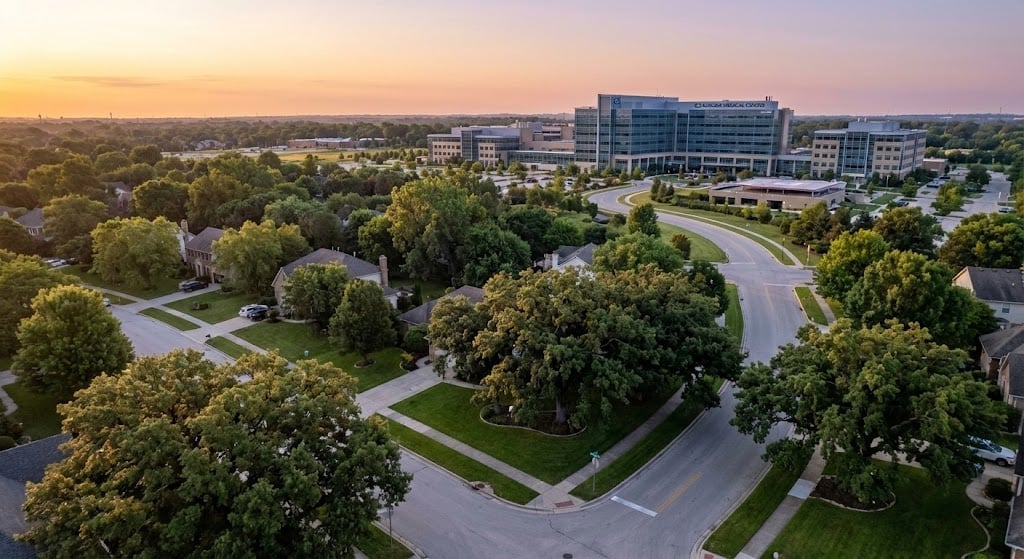
BSW Temple operates as a Level I Adult Trauma Center and Level II Pediatric Trauma Center — designations that require 24/7 specialist coverage across dozens of surgical and medical subspecialties. Those coverage requirements create perpetual demand for locum tenens physicians, traveling specialists, and rotating trainees. Add McLane Children’s Hospital (the only dedicated pediatric facility between Austin and Dallas) and the Olin E. Teague VA Center (serving one of the largest veteran populations in Texas), and you have three major medical facilities within a 2-mile radius all generating housing demand for non-permanent medical professionals.
The 47 GME programs alone cycle hundreds of trainees through Temple annually. Each July brings a new intern class. Each academic quarter brings new clinical rotators. Each coverage gap brings a new locum placement. This is not seasonal demand — it is institutional, structural, and recession-resistant. Sick people do not stop needing Level I trauma care during economic downturns. BSW does not furlough its residency programs when the stock market drops.
BSW’s GME ecosystem creates demand that does not correlate with economic cycles.
Where the Spreadsheet Lies to You
“The occupancy rate IS the entire thesis. Below 80%, you are working harder for less money than a landlord who bought an unfurnished rental and went to sleep.”
Taylor Dasch — EG Realty
The Break-Even Occupancy Gauge
Where Each Strategy Actually Works
Zone 1: Hospital District & Canyon Creek
Zone 2: West Temple & Bella Terra
Zone 3: South Temple & Master-Planned
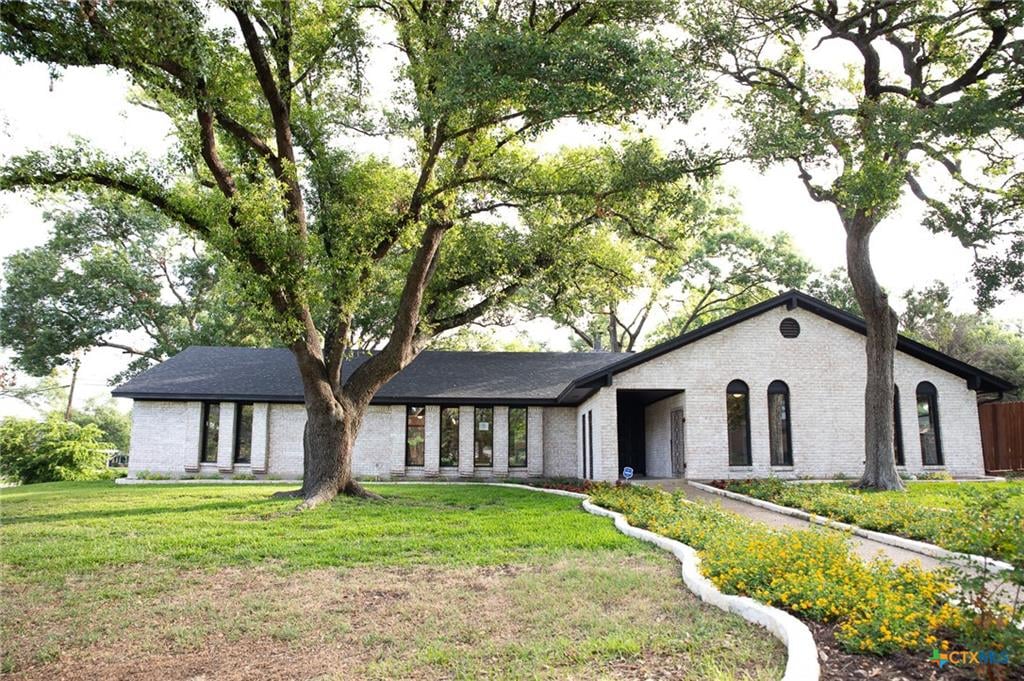
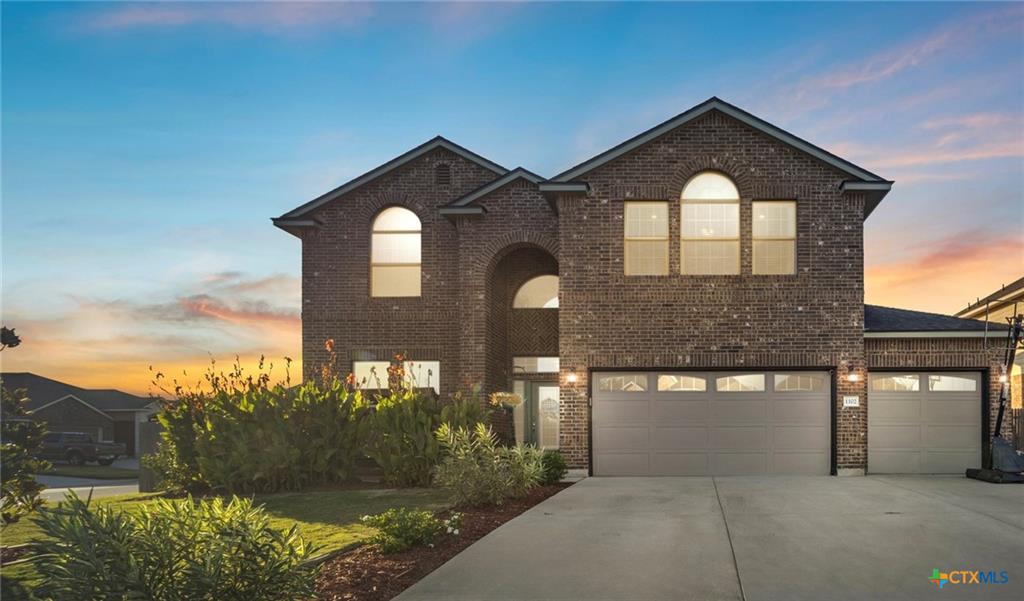
Zone 1 properties like this Western Hills home provide the low-basis advantage that makes MTR math work.
Can Texas HOAs Foreclose on Your Investment Property?
Lake Pointe
Explicitly prohibits any lease under 6 months. Furnished MTR is completely off the table. LTR only.
Bella Terra
Allows 30+ day stays but blocks short-term. Technically allows MTR but HOA culture is not investor-friendly. Proceed with caution.
Wyndham Hill
Active HOA with lease-duration restrictions that effectively block furnished MTR. Verify specific CC&R language before closing.
Texas Case Law You Need to Know
Tarr v. Timberwood Park Owners Association (2016): The Texas Supreme Court ruled that generic “residential use only” language in CC&Rs is insufficient to ban rentals. HOAs must have EXPLICIT language restricting rental activity, lease durations, or tenant types. This means: if the CC&Rs do not specifically mention lease minimums or rental restrictions, a general “residential purposes” clause alone cannot stop you from operating a furnished rental.
The catch: Most newer Temple HOAs (post-2018) have updated their CC&Rs with explicit rental restriction language specifically because of Tarr. Do not assume you are protected. Pull the actual CC&Rs and read them — or have a Texas real estate attorney review them — before closing. The $300 attorney review fee is the best insurance policy in this entire strategy.
For a comprehensive breakdown of every Bell County HOA’s rental restrictions, read the HOA Rental Restrictions Guide for Temple & Belton.
The Legal Margin Advantage Over Airbnb Operators
Under the Texas Permanent Resident Exemption, any guest staying 30 or more consecutive days is classified as a “permanent resident” and is fully exempt from Hotel Occupancy Tax (HOT). This means Airbnb operators running nightly or weekly stays pay a combined 13% tax on every dollar of revenue that you, as a 30+ day MTR operator, do not.
On a $2,500/month gross rental, that 13% tax represents $325/month in margin advantage over short-term operators — before accounting for the lower turnover costs and reduced guest communication overhead that 30+ day leases provide. This is the legal foundation of the entire mid-term rental strategy in Texas.
The Non-Negotiable Rule
Enforce a 30-day minimum lease on every single placement. No exceptions. Not even for a locum who says they only need 21 days. The moment you accept a sub-30-day stay, you owe 13% HOT on that revenue and you open yourself to municipal STR regulation scrutiny. The 30-day floor is not a suggestion — it is the structural foundation that keeps this strategy legal, tax-efficient, and sustainable.
What to Buy — And What to Avoid
What to Buy for MTR
- Older 2/1 & 3/2 single-family homes in Canyon Creek and the Hospital District
- Low acquisition cost ($140K–$250K) creates the yield spread that absorbs operational drag
- Duplexes and small multifamily — economies of scale on cleaning, lawn, pest control
- Must-have: in-unit washer/dryer (not shared, not coin-op)
- Must-have: covered parking (night-shift workers need shade and weather protection)
- Must-have: blackout curtains in every bedroom (non-negotiable for night-shift workers)
- Must-have: dedicated desk + ergonomic chair (residents study constantly)
- Must-have: high-speed WiFi (250+ Mbps) with hardwired ethernet option
- Properties with fenced yards command premium from pet-owning travel nurses
What to Avoid
- New construction in West/South Temple — $300K+ basis compresses yield below LTR benchmarks
- Condos and townhomes with HOA restrictions — lease-duration traps
- 4+ bedroom homes — unnecessary furnishing cost ($5K+ additional), higher cooling bills ($60–$120/mo summer premium), longer vacancy between turns
- Properties more than 10 minutes from BSW — the convenience premium evaporates
- Slab foundations with known movement history — Bell County expansive clay is aggressive; get an engineer’s report before closing
- Homes on busy streets — night-shift workers will not tolerate traffic noise during daytime sleep
- Properties without covered parking — 100°F+ summer heat destroys vehicles and makes the 6am walk to the car miserable
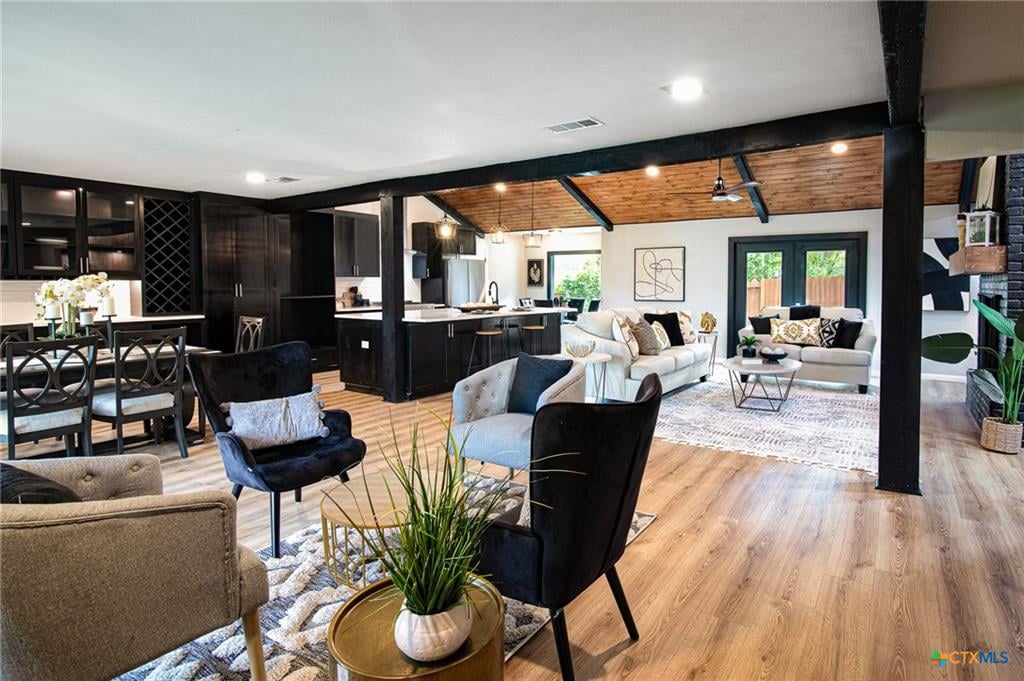
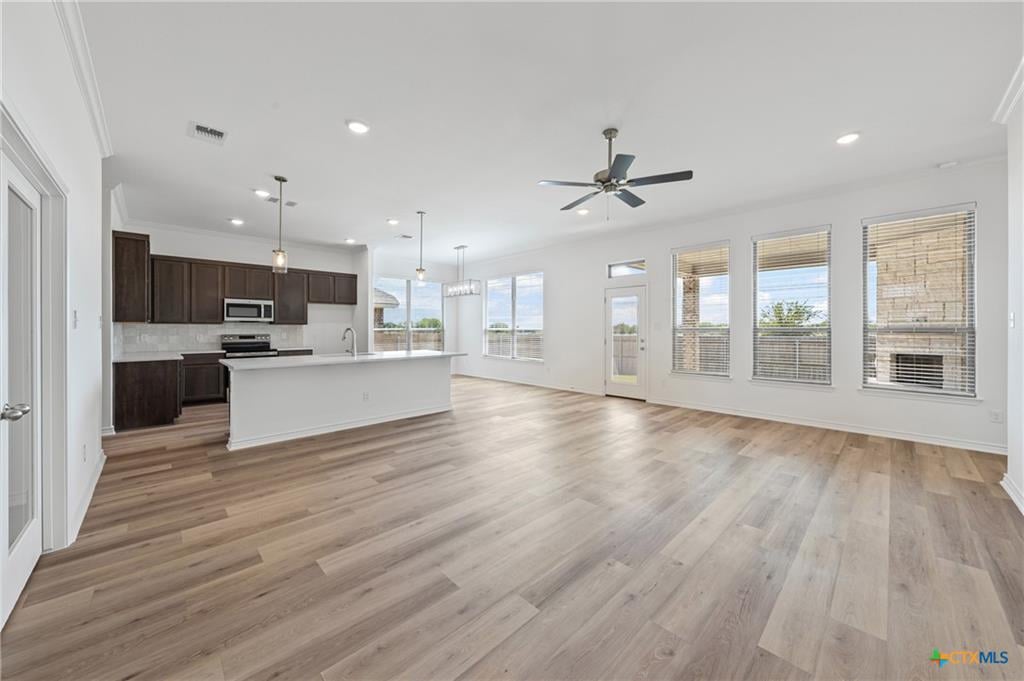
Open-concept layouts are preferred by all 5 renter personas. A clean, functional Western Hills interior is Zone 1 ready.
How Much It Actually Costs to Furnish for Medical Housing
- 2 queen beds + quality mattresses$1,200–$1,800
- Living room (sofa, coffee table, TV stand)$800–$1,200
- Complete kitchenware (plates, pots, utensils)$300–$500
- Linens (sheets, towels, pillows)$400–$600
- TVs (2× smart TV)$400–$600
- Desk + ergonomic chair$250–$400
- Blackout curtains (all rooms)$150–$250
- Consumables starter kit$100–$200
- 3 beds + premium mattresses (king master)$2,400–$3,600
- Living room (sectional, accent chairs, media)$1,500–$2,500
- Dining set (4–6 seats)$400–$800
- Complete kitchenware + small appliances$500–$800
- Premium linens (hotel-quality)$600–$1,000
- Smart TVs (3×) + streaming$600–$900
- Home office setup (standing desk option)$400–$700
- Blackout curtains + window treatments$300–$500
- Outdoor furniture (patio set)$300–$500
- Consumables + welcome kit$200–$400
The Furnishing Rule
Do NOT over-improve for medical students. They need clean, functional, and quiet. A $6,000 furniture package is perfectly adequate. They will not pay more for a West Elm sofa. DO invest in premium finishes for locum tenens. Their housing is corporate-expensed and they expect quality. A $24,000 package with a king mattress, standing desk, and quality kitchen pays for itself in the $200–$400/month premium you can command. Amortize all furnishing over 3–5 years and replace worn items before they become complaints.
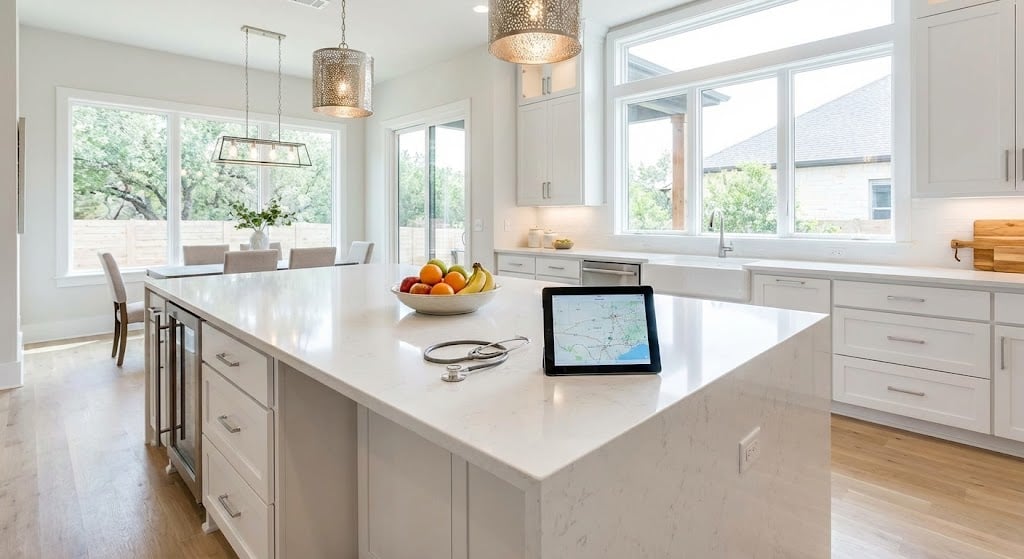
Premium kitchen finishes justify the locum tenens price point — this level of investment makes sense at $24K, not at $8K.
The Honest Math From Someone Who’s Done It
I have bought and renovated properties specifically for furnished medical housing near BSW. Here is what I learned the hard way: the spreadsheet lies to you if you underwrite at 90% occupancy. I model at 75% and I have never been disappointed with reality exceeding my conservative number. The investors who call me panicking are always the ones who modeled at 95% because that is what a blog post told them was “realistic for high-demand hospital markets.”
The investors I see fail at this strategy make three mistakes: they buy in HOA neighborhoods that explicitly ban it (and discover this after they have spent $15,000 furnishing the place), they furnish a $350K new build in Bella Terra when a $180K Canyon Creek fixer would have doubled their yield, and they try to manage it from out of state without local boots on the ground. Furnished rental management is not property management. It is hospitality management. Different skill set. Different vendor relationships. Different time commitment.
This is NOT passive income. It is a hospitality business. You need a reliable cleaner who can turn the property in 24 hours with zero excuses. You need a lawn service that does not flake in August when it is 105 degrees. You need a handyman on speed dial who answers on Saturday mornings. If you have those three relationships locked down and you are buying older stock near the hospital — the math is very, very good.
But if you do not have those relationships? Buy a $1,650/month unfurnished rental in a Belton ISD neighborhood and sleep like a baby. There is no shame in the passive play. The worst outcome in real estate investing is not lower returns — it is operational burnout that causes you to fire-sell a property at the wrong time.
Have a specific property in mind? Text Taylor directly → 254-718-4249
“Model at 75% occupancy. If you cannot stomach the returns at that number, buy an unfurnished LTR and go to sleep. The spreadsheet at 90% is not a plan — it is a prayer.”
Taylor Dasch — EG Realty
What the Big Sites Will Not Tell You
The “Trojan Horse” Thesis
Travel nurse SEO drives traffic, but medical housing drives yields. This page ranks for “travel nurse housing investment” because that is what investors search for. But you just spent 20 minutes learning that the real strategy is underwriting for BSW’s 47 GME programs — 5 tenant types, not 1. Every investor blog on the internet optimizes for the wrong keyword AND the wrong thesis. You now know both.
Night Shift Non-Negotiables
The ungoogleable details that determine whether a medical professional extends or leaves a negative review: blackout curtains in every bedroom (not just the master), covered parking (walking to a 140-degree car at 7am after a 12-hour shift is miserable), and sound dampening (no busy street frontage, consider adding weatherstripping to interior doors). These three items cost under $500 combined and are the #1 driver of lease extensions.
The Social Worker Pipeline
McLane Children’s Hospital social workers actively place patient families in local housing during extended treatment stays. This is not on any listing platform. Building a relationship with the McLane social work team — a simple introductory email with your property details and pricing — creates a direct referral pipeline that bypasses Furnished Finder entirely. Zero platform fees. Zero marketing cost. The most capital-efficient tenant acquisition channel in this entire strategy.
The Liquidation Trap
Converting a furnished MTR back to an unfurnished LTR sounds simple until you do the math. $8,000–$24,000 in furniture that has been used by 8–12 tenants over 3 years has approximately $0 resale value. Facebook Marketplace will net you $500–$1,500 for the entire package if you are aggressive about pricing. The rest goes to the curb. Budget this reality into your exit strategy from day one. The furniture is a sunk cost — not an asset.
The Cleaning Economy
Turn cleaning is a line item most spreadsheets either skip or dramatically underestimate. Professional deep cleaning between medical tenants (who work with infectious patients) runs $100–$250 per turn depending on home size. At 4 turns per year, that is $400–$1,000 annually — or $33–$83/month. The $50/month we modeled in the Cost Stack is conservative. And you need a cleaner who can execute within 24 hours of tenant departure with zero excuses. Cleaners who cancel or delay cost you days of revenue.
The Lawn Care Summer Drag
Central Texas grass grows aggressively from April through October. Bi-weekly mowing at $44/cut means $88/month for 7 months — an invisible $616 annual cost that does not appear on any rental income calculator. Add edging, seasonal fertilization, and weed treatment, and you are closer to $800–$1,000/year. This is your responsibility as the operator, not the tenant’s. Budget it.
15 Investor Questions — Answered With Data
Is Temple TX good for travel nurse housing investment?
Yes — but the investment thesis should be broader than “travel nurse housing.” Baylor Scott & White’s 47 GME programs (21 residency + 26 fellowship) create 5 distinct renter profiles that rotate through Temple continuously. Travel nurses represent roughly 25% of furnished housing demand near BSW. The remaining 75% — medical residents, fellows, visiting students, locum tenens physicians, and patient families at McLane Children’s Hospital — provide the durable, recession-resistant demand floor that makes this strategy viable through economic cycles. The critical qualification: the math only works in older, low-basis properties within 7 minutes of BSW, outside of HOA restrictions (Zone 1). Buying in Zone 2 or Zone 3 for furnished MTR is the most common and most expensive mistake investors make.
How many medical programs does BSW Temple operate?
47 Graduate Medical Education (GME) programs — 21 residency programs and 26 fellowship programs — creating a continuously rotating tenant pool of young physicians requiring 1–36 month housing. BSW Temple is a 636-bed Level I Adult Trauma Center and Level II Pediatric Trauma Center with 8,800+ employees, making it the largest employer in Bell County. These GME programs cycle hundreds of trainees through Temple annually, with new intern classes arriving each July. Add McLane Children’s Hospital and the Olin E. Teague VA Center within a 2-mile radius, and the combined medical ecosystem generates perpetual demand for furnished housing that does not correlate with economic cycles.
What areas near BSW work best for furnished rental investment?
Canyon Creek and the Hospital District (Zone 1), within 3–7 minutes of BSW. Older 2/1 and 3/2 single-family homes at $140K–$350K acquisition cost provide the yield spread needed to absorb furnishing CapEx ($6K–$24K), operational costs ($632–$782/month), and vacancy drag (model 25%+ vacancy). Avoid Zone 2 (Bella Terra, Lake Pointe, 8–12 min from BSW) for MTR — HOA restrictions and higher acquisition costs compress yields below unfurnished LTR benchmarks. Zone 3 (South Temple, Prairie Ridge, 10–15+ min) is strict LTR only. The neighborhood guide has detailed zone analysis for every Temple community.
Do I pay hotel occupancy tax on 30+ day rentals in Temple?
No. Texas’s “Permanent Resident Exemption” classifies any guest staying 30 or more consecutive days as a permanent resident, fully exempt from the 6% state Hotel Occupancy Tax and the 7% City of Temple Hotel Occupancy Tax. This combined 13% margin advantage over Airbnb and short-term rental operators is the legal foundation of the mid-term rental strategy. On $2,500/month gross revenue, that is $325/month in tax savings versus nightly/weekly operators. The non-negotiable rule: enforce a 30-day minimum lease on every single placement. No exceptions. The moment you accept a sub-30-day stay, you owe HOT on that revenue and expose yourself to municipal STR regulation scrutiny.
Can HOAs ban furnished mid-term rentals in Temple?
Yes. Many master-planned communities in Temple and Belton enforce lease-duration minimums in their CC&Rs. Lake Pointe requires 6-month minimum leases. Bella Terra allows 30+ day stays but the HOA culture is not investor-friendly. Wyndham Hill has explicit lease-duration restrictions. Under Texas law, HOAs can foreclose on your property for unpaid violation fines — this is not a theoretical risk. The Tarr v. Timberwood Park (2016) ruling established that generic “residential use only” language is insufficient to ban rentals, but most newer Temple HOAs (post-2018) have updated CC&Rs with explicit rental restriction language. Always pull and read the actual CC&Rs before closing, or pay $300 for a Texas real estate attorney review. Read the full HOA rental restrictions guide.
What does it cost to operate a furnished rental in Temple monthly?
On a 3BR home grossing $2,500/month: utilities $200–$350 (operator-paid), high-speed internet $70, lawn care $88/month (summer average, $44/cut bi-weekly April–October), pest control $40, turn cleaning amortized $50/month ($150 per turn × ~4 turns/year), furnishing CapEx amortized $167/month ($8,000 over 4 years), platform fees $17/month ($199/year Furnished Finder). Total operational drag: $632–$782/month BEFORE vacancy. At 75% occupancy (conservative but honest), effective gross drops to $1,875 and net yield after all costs is approximately $1,143/month — which is $257 below a $1,400 unfurnished LTR that requires zero operational effort. The math only clears LTR at 90%+ occupancy, achievable exclusively in Zone 1.
How much does it cost to furnish a 3-bedroom in Temple?
$6,000–$10,000 for a 2/1 targeting medical students and budget-conscious travelers. $15,000–$24,000 for a 3/2 targeting travel nurses and locum tenens physicians. The spread depends on finish quality and persona targeting. Medical students need clean, functional, and quiet — not premium. A $6K furniture package with quality mattresses, blackout curtains, a desk, and complete kitchenware is perfectly adequate. Locum tenens physicians are corporate-expensed and expect quality — invest in a king mattress, standing desk option, premium kitchen, and hotel-quality linens. The $200–$400/month premium they pay covers the incremental furnishing cost within 6–12 months. Amortize all furnishing over 3–5 years and replace worn items proactively before they become guest complaints.
Should out-of-state investors do furnished rentals in Temple?
Generally no — unless they have reliable local infrastructure already in place: a cleaner who can turn the property within 24 hours, a lawn service that will not flake during 105-degree August weeks, and a handyman on speed dial for Saturday morning emergencies. Furnished medical housing is active hospitality management, not passive property management. The operational tempo is fundamentally different from unfurnished LTR ownership. Out-of-state investors without existing local vendor relationships should buy unfurnished LTRs in Belton ISD neighborhoods instead — $1,400–$1,700/month in cash flow with near-zero operational burden. Read the out-of-state investor guide for the full breakdown.
Is “travel nurse housing” too narrow as an investment thesis?
Yes. Post-COVID travel nurse demand has normalized significantly — contract rates have compressed 40–60% from their 2021–2022 peaks, and agencies are more selective about housing stipends. Nationally, Furnished Finder data shows travel nurses represent approximately 25% of furnished housing demand. The durable thesis is “furnished medical housing” serving BSW’s 47 GME programs. The five renter personas — medical students, residents/fellows, travel nurses, locum tenens physicians, and patient families — create a diversified demand base that is recession-resistant because healthcare utilization does not decline during economic downturns. Investors who underwrite for only travel nurses miss 75% of their addressable market and are vulnerable to single-source demand risk.
What is a realistic occupancy rate for furnished housing in Temple?
Conservative underwriting should model 60–65% occupancy. Furnished Finder platform data shows 56% average occupancy for Temple listings — though this includes properties in Zones 2 and 3 that should not be operating as furnished rentals at all. Only properties in Zone 1 (within 7 minutes of BSW, no HOA restrictions) consistently achieve 80%+ occupancy. The critical break-even threshold is approximately 75–80% — below this, net MTR yield falls below unfurnished LTR benchmarks and you are working significantly harder for less money. Model at 75% for your base case. If the returns are not acceptable at 75%, the property is not right for this strategy.
Are travel nurses the main renters for furnished properties near BSW?
No. The five renter profiles in order of demand durability: (1) rotating residents and fellows from BSW’s 47 GME programs (most consistent, institutional demand), (2) medical students on 4–8 week clinical blocks (high turnover, budget-sensitive, shared housing acceptable), (3) travel nurses on 13–26 week contracts (the most marketed-to but only ~25% of actual demand), (4) locum tenens physicians on 1–6 month assignments (highest revenue per tenant, corporate-expensed), (5) patient families at McLane Children’s and the VA (variable duration, accessible housing required). Investors who underwrite for only nurses miss 75% of the addressable market and create unnecessary demand concentration risk in their portfolio.
What makes Canyon Creek ideal for furnished medical housing?
Canyon Creek is 3–5 minutes from BSW, has minimal or no HOA restrictions, features older housing stock at $140K–$250K acquisition cost, and allows short-duration leases without community governance interference. The low basis is the structural advantage: a $180K Canyon Creek 3/2 grossing $2,500/month in furnished rent has a fundamentally different yield profile than a $350K Bella Terra home grossing the same amount. The $170K acquisition cost difference translates to ~$1,000/month in lower mortgage payment, which converts directly to higher cash-on-cash return. Canyon Creek’s older homes need more maintenance (budget $2,000–$4,000/year), but the basis advantage more than compensates. Explore Canyon Creek details.
How long do medical residents typically rent furnished housing?
1–3 months for transition housing. Most incoming residents (PGY-1 starting at $70,993/year at BSW) use furnished rentals as a “landing pad” while they search for permanent housing, wait for a partner to relocate, or evaluate Temple neighborhoods before committing to a purchase. They are NOT long-term tenants and investors should not underwrite for 12-month stays. The typical pattern: arrive in late June, move into furnished rental for July–September, find permanent housing or buy a home by October. Some fellows on 1–2 year programs will stay longer, but the majority of resident-driven demand is concentrated in the June–September transition window. This creates a seasonal demand peak that Zone 1 operators should plan for.
What property type works best for furnished medical housing?
Older 2/1 and 3/2 single-family homes and duplexes in Zone 1 (Canyon Creek, Hospital District). Duplexes offer economies of scale — one lawn service contract, one pest control contract, shared maintenance vendor relationships — while doubling your per-property revenue. Avoid new construction ($300K+ basis compresses yield below LTR benchmarks), condos and townhomes (HOA lease-duration traps), and 4+ bedroom homes (unnecessary $5K+ additional furnishing cost, $60–$120/month higher cooling bills in summer, and longer vacancy between turns because the tenant pool for 4BR furnished housing is smaller). The ideal acquisition: a $150K–$220K 3/2 in Canyon Creek with in-unit laundry, covered parking, and a fenced yard. Use the deal analyzer to model specific properties.
Is a mid-term rental considered a short-term rental in Temple?
No. Under Texas law, stays of 30 or more consecutive days are classified as “permanent residency” and are treated under standard residential lease law — not hotel or short-term rental regulations. This classification provides three critical protections: (1) full exemption from the combined 13% Hotel Occupancy Tax (6% state + 7% city), (2) treatment under residential landlord-tenant law rather than hospitality regulations, and (3) exemption from any municipal short-term rental licensing, permitting, or registration requirements that Temple may implement in the future. This legal distinction is the structural foundation that protects MTR operators and creates the margin advantage over Airbnb-style nightly rentals. Enforce the 30-day minimum on every lease without exception.
Temple Medical Housing — Properties, Neighborhoods, Interiors

Ready to Underwrite Your First Temple Medical Housing Deal?
Get a no-pressure analysis of any property near BSW. Taylor will run the real numbers — including the costs that spreadsheet templates skip.
Current inventory, screened · MLS pull Aug 12, 2026
3 Current Fits + 1 Caution
Three on-market homes right now that pencil for furnished 30+ day rentals near BSW — and one that looks right on paper but isn’t, with the reason.
The band is deep enough to be picky. The screen that matters isn’t price — it’s layout, parking, HOA posture and the walk-to-shift math that decides whether a nurse books your unit or the one closer in.
What you get
- 3 specific current listings that fit the furnished 30+ day model, with the why per address
- 1 caution: the listing type that shows up in every spreadsheet and underperforms in practice
- The acquisition math on each — at real closed prices, not pro-forma hopes
Taylor operates his own furnished rental a half-mile from the BSW campus — this is his screen, applied to this week’s inventory.
Data: CTXMLS whole-market export, pulled Aug 12, 2026 · closings counted Feb 6 – Aug 12, 2026 · computed directly from the raw export, not estimated.