BSW Physician Relocation · Temple, TX
The Real Estate Agent Physicians Hire to Relocate to Baylor Scott & White
If you matched, signed, or are weighing an offer at BSW Temple, you don’t need a generalist agent — you need one who knows the physician-mortgage lenders, the Match Day timeline, and which Belton ISD addresses hide inside Temple ZIP codes. That’s the job I do.
Hire an agent who specializes in physician relocation to Baylor Scott & White — not a general residential agent. The decisions that make or break a BSW move are specialist decisions: which local lenders write physician mortgages (0% down, no PMI, student debt excluded from DTI), how to time a purchase against the June resident crunch, and how to verify whether a Temple-addressed home is actually zoned to Belton ISD. Taylor Dasch (EG Realty, Temple) ranks #28 of 2,013 Bell County agents and has closed for BSW residents, attendings, allied-health staff, and an international medical graduate who signed before she landed in Texas. This page shows exactly what that specialization buys you — and the five questions to ask any agent before you hire them.
Why Physicians Relocating to BSW Need a Specialist, Not a Generalist
A good general agent can open doors and write a contract. But a BSW physician relocation has four decisions a generalist routinely gets wrong — and each one costs real money or real sleep:
- Physician-mortgage documentation. A signed employment contract can stand in for pay stubs, and deferred student loans can be excluded from your debt-to-income ratio — but only if your lender writes true physician loans and your agent structures the timeline around it. A generalist points you at a retail lender and you lose the advantage.
- Match Day timing. The window that matters opens in mid-March, not at orientation. Miss it and you’re house-hunting against 100–150 other new residents in June.
- Belton ISD address arbitrage. Some homes with a Temple mailing address are zoned to Belton ISD and carry a $20,000–$40,000 premium for it. Boundaries shifted in 2024. Zillow’s school data is not authoritative here — the address is.
- Post-call sleep corridors. Which streets sit under the ambulance route to the BSW ER, beside the BNSF rail line, or under the trauma helipad’s approach. A generalist has never had a client working nights; you will.
Get those four right and the move is smooth. Get them wrong and you’ve overpaid, missed the good inventory, or bought a house you can’t sleep in after a night shift.
Taylor Dasch’s BSW Relocation Track Record
Specialist is a claim most agents assert and few can back. Here is the evidence behind it:
- Ranked #28 of 2,013 Bell County agents — top 1.4% — with 100+ closings and $27M+ in volume across Temple, Belton, and the wider Central Texas corridor.
- Residents & fellows: closed physician-mortgage purchases for PGY-level buyers using a signed BSW contract as income, before the first paycheck cleared — timed to beat the June crunch.
- Attending physicians: placed families in Canyon Creek and the Lake Pointe / Hills of Westwood Belton ISD corridor after verifying school zoning by exact address, not by neighborhood name.
- Allied health (RN / NP / CRNA): matched 12-hour shift workers to west-side neighborhoods chosen for the 7am drive home, not just the drive in.
- International medical graduate: guided a J-1 fellow through an employment-letter lease and a sight-unseen purchase — paperwork signed before she arrived in Texas.
The point of the list isn’t the count. It’s that each of these buyers needed something a general agent has never handled. Full context on the market and the hospital is in the Baylor Scott & White relocation guide.
5 Questions to Ask Any Agent Before Hiring Them for a Physician Relocation
Use these as a filter. A BSW specialist answers all five without hesitation; a generalist stalls on at least three. Ask them before you sign a buyer-representation agreement with anyone.
- Which local lenders write true physician mortgages, and how do their terms differ? The right answer names Extraco Banks (headquartered in Temple), First Lonestar Financial, Regions, and Truist — and explains that the ~0.25%–0.75% rate premium is usually cheaper monthly than PMI on a conventional loan.
- When should a matched resident start looking, and why? The right answer is mid-March — Match Day — because 100–150 new residents and fellows arrive each June and the closest neighborhoods tighten fast.
- How do you verify whether a Temple address is zoned to Belton ISD? The right answer is by exact address against the current district boundary map — not by ZIP, not by Zillow, and with awareness that boundaries moved in 2024.
- Which neighborhoods work for a night-shift schedule, and which don’t? The right answer names the rail corridor, ER ambulance routes, and the trauma helipad — and picks housing for daytime sleep and the 7am commute home.
- Should I rent or buy for my program length? The right answer is honest: programs under three years usually rent (you need roughly five years to recoup closing costs at Temple’s tight sale-to-list ratios); four-year programs and attendings usually buy at Temple’s entry prices with 0% physician financing.
Physician Mortgage Lenders for BSW Employees (Local Matrix)
Physician loans trade a small rate premium for structure that fits a doctor’s balance sheet: no down payment, no PMI, deferred student loans excluded from DTI, and a signed contract accepted as proof of income. Here is how the local options compare. Rates move — confirm current terms with each lender before you decide.
| Lender | Why it matters for BSW | Structure |
|---|---|---|
| Extraco Banks | Headquartered in Temple; understands BSW contract structures and closes fast locally | 0% down up to ~$750K; contract-as-income |
| First Lonestar Financial | Central Texas lender familiar with the resident timeline | 0% down; student debt excluded from DTI |
| Regions | National physician-loan program with broad specialty coverage | 0% down to high loan limits; no PMI |
| Truist | Physician program covering residents through established attendings | Low/0% down; PMI waived |
The honest math: a physician loan often runs about $70–$80 more per month in interest on a ~$260K balance versus a conventional loan — but you skip $175–$250/month in PMI, so the physician loan is usually cheaper every month and preserves your cash. Deeper detail lives on the physician mortgage guide for Central Texas.
The Match Day to Move-In Timeline for BSW Residents
Match Day is the starting gun, not orientation day. Physicians who contact an agent in mid-March get roughly 90 days of low-competition inventory before the crunch. Those who wait until May compete on the same streets against dozens of peers.
| When | Move | Why |
|---|---|---|
| Match Day (~mid-March) | Contact a BSW specialist agent + physician-loan lender | ~90 days before the June crunch — the best inventory window |
| Week of Match Day | Get pre-approved on your signed contract | No pay stubs required; student loans excluded from DTI |
| April | Tour and narrow to one or two target zones | Canyon Creek, Western Hills, and Lake Pointe move first |
| April–May | Offer; negotiate builder incentives on new construction | Rate buydowns still being offered in 2026 |
| May–June | Close 2–4 weeks before July 1 | You own before day one; equity accrues immediately |
A month-by-month version is on the Match Day housing timeline.
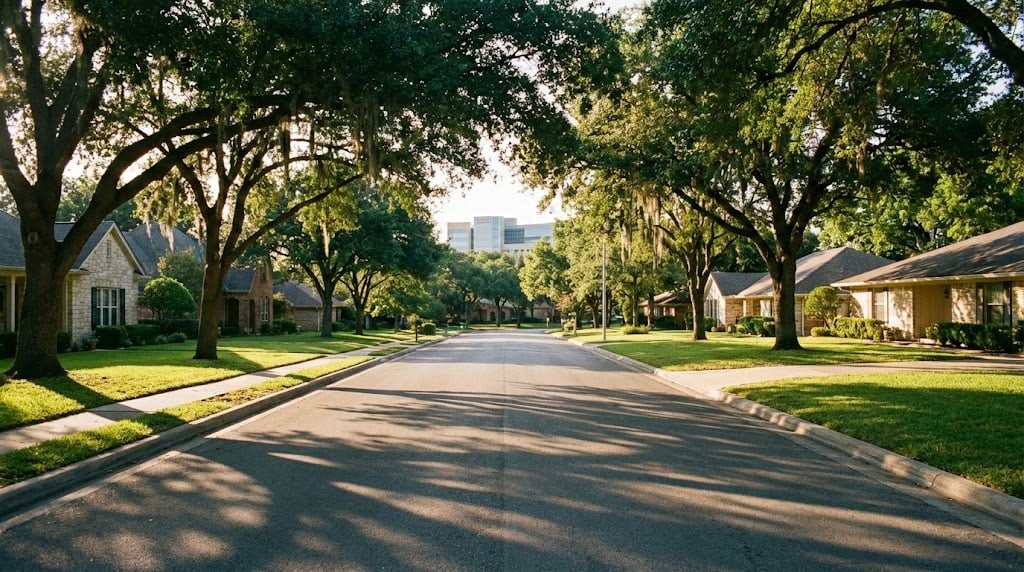
Where BSW Physicians Live — Commute, Schools, and Night-Shift Corridors
Most BSW buyers cluster in a handful of west-side neighborhoods for three reasons: short commutes, school access, and quiet. The tradeoffs are specific:
- Canyon Creek — 5–8 minutes to BSW, Temple ISD, no PID; the default for attendings who want the shortest commute at a $335K–$555K range.
- Western Hills — 5–7 minutes, $223K–$245K, no MUD/PID; the value pick for residents and allied-health staff, and quiet for daytime sleepers.
- Lake Pointe / Hills of Westwood — 8–18 minutes, Belton ISD inside a Temple address; the family choice, with the $20K–$40K Belton ISD premium baked in. Verify zoning by exact address.
- TMED (Temple Medical & Education District) — a 1–3 minute walk, $150K–$300K; unbeatable for residents on call, with rail-corridor noise to screen for.
Commute and school detail by neighborhood is mapped on Neighborhoods Near BSW by Commute and Best Neighborhoods in Temple TX.
Where Austin Comes Up
Many BSW recruits are also weighing an Austin academic offer. Temple’s median home price (~$270K vs. Austin’s $525K+) narrows the Austin salary premium sharply once housing is in the math — a $40,000 salary gap can net to roughly $17K–$18K a year after housing, before you count the commute. The full comparison, with the equity and after-tax angle, is on Temple vs. Austin for Physicians. If you’re still deciding whether to sign at all, start with Should You Accept the BSW Offer?
Rent or Buy? The Honest Answer by Program Length
No agent should push you to buy. The math is program-length dependent:
- Under three years (many residencies): usually rent. Closing costs run 2–3% of price, and Temple’s tight sale-to-list ratio leaves little appreciation to offset them in a short hold.
- Four-plus years and attendings: usually buy. Temple entry prices plus 0% physician financing mean your payment builds equity instead of a landlord’s.
- Fellows (2–3 years) with any chance of staying: buying with a physician loan is low-risk on cash; target the most liquid neighborhoods (Canyon Creek, TMED) in case you need to sell.
The full breakdown is on Rent vs. Buy for BSW Residents.
Book a Physician Relocation Consult
Tell me your role at BSW, your program length, and your timeline. I’ll send back the physician-mortgage lenders that fit, the neighborhoods that match your commute and schools, and a straight answer on rent vs. buy for your situation. No pitch — just the plan.
Prefer to talk? Call or text 254-718-4249 · dealswithdasch@gmail.com · Taylor Dasch, EG Realty, Temple TX
Frequently Asked Questions
Do I need a physician-specific real estate agent to move to BSW Temple?
Not legally, but it changes the outcome. A physician relocation turns on decisions a general agent rarely handles: which local lenders write 0%-down physician mortgages, how to time a purchase against the June resident crunch, whether a Temple address is zoned to Belton ISD, and which neighborhoods work for night-shift sleep. An agent who has closed these moves protects you on all four.
Can a BSW resident buy a home with 0% down?
Yes. Physician mortgage loans let residents purchase with 0% down using a signed employment contract as proof of income — no pay stubs required — and exclude deferred student loans from the debt-to-income calculation. A PGY-1 earning about $70,993 typically qualifies for roughly $240,000–$280,000. Local lenders that write these include Extraco Banks, First Lonestar, Regions, and Truist.
When should a matched resident start house-hunting in Temple?
Immediately after Match Day in mid-March. Roughly 100–150 new residents and fellows arrive at BSW each June and search the same close-in neighborhoods at once. Starting in March gives you about 90 days of low-competition inventory and time to get pre-approved on your contract before the crunch.
Which Temple neighborhoods are zoned to Belton ISD?
Several Temple-addressed neighborhoods — including parts of Lake Pointe and Hills of Westwood — are zoned to Belton ISD, which outperforms Temple ISD on state assessments and carries a $20,000–$40,000 price premium. District boundaries shifted in 2024, so zoning must be verified by exact street address, not by ZIP code or a listing portal.
How much does a buyer’s agent cost a physician in Texas?
In most Central Texas transactions the buyer’s-agent fee is addressed in the purchase negotiation, and for many buyers it is covered through the deal structure rather than paid out of pocket. The specifics are set in your buyer-representation agreement — ask any agent to walk you through exactly how they’re compensated before you sign.
What makes an agent a BSW relocation specialist?
Specific, provable knowledge: the local physician-mortgage lender matrix, the Match Day–to–July timeline, address-level Belton ISD boundaries, and the night-shift noise corridors around the hospital — backed by actual closings for BSW residents, attendings, allied-health staff, and international medical graduates.