


How to Buy Investment Property in Temple TX Remotely
The complete remote acquisition guide: financing, due diligence, zip code strategy, and closing — without ever boarding a plane. Data current as of March 2026.
Can I Buy Investment Property in Temple TX Without Visiting?
Yes. As of March 2026, approximately 60% of investor transactions in Temple TX close with an out-of-state buyer who never visits the property in person. Texas legalized Remote Online Notarization (RON) in 2018, meaning you can sign closing documents via secure video link from any state. The typical remote acquisition takes 30–45 days from executed contract to close, with a median purchase price of $240K for a 3BR/2BA built after 2018 that rents for $1,750/month on a long-term lease. Your critical success factor is assembling a local team — investor-focused agent, property manager, and inspector — before you ever submit an offer.
Key Facts About Remote Investing in Temple TX:
- Texas has 0% state income tax on rental income — one of only nine states
- RON closing costs add $75–150 per session; no in-person requirement
- DSCR loans available from 6.1–7.5% with no W-2 required (March 2026 rates)
- Effective property tax rate: 2.07%, which equals $4,968/year on a $240K property
- SB 38 (effective Jan 2026) streamlined eviction to as few as 21 days from filing to judgment
- Baylor Scott & White (8,800+ employees) and Fort Cavazos create a dual-anchor tenant pool
Why Are Out-of-State Investors Choosing Temple TX in 2026?
Temple’s median home price of $255,731 (Zillow, March 2026) sits 42% below the national median — and roughly 55% below Austin’s. For remote investors priced out of gateway markets, that spread is the entire thesis. But entry price alone doesn’t explain why capital keeps flowing here. The fundamentals do.
Dual economic anchors eliminate single-employer risk. Baylor Scott & White Medical Center — Temple employs 8,800+ workers across one of the nation’s largest integrated health systems. Fort Cavazos (formerly Fort Hood), the Army’s largest active-duty post, drives consistent housing demand through PCS rotations, BAH-backed rents, and a 50,000+ soldier population. These two institutions create a tenant pipeline that doesn’t depend on tech cycles or corporate relocations.
Zero state income tax. Texas is one of nine states with no personal income tax, meaning your rental cash flow keeps 100% at the state level. For a California or New York investor earning $20K/year net from Temple rentals, the tax savings alone can exceed $2,000 annually compared to a state with 10%+ income tax.
Landlord-friendly legal framework. Senate Bill 38, effective January 1, 2026, further streamlined Texas eviction law. Trial dates must now be set within 10–21 days of filing. Unauthorized occupants can face judgment in as few as five days. Tenants appealing must post one month’s rent into court escrow and swear under penalty of perjury that they have a meritorious defense. No moratorium overrides are permitted — eviction timelines are now consistent across all 254 Texas counties. Compare that to California’s 60–90+ day eviction process.
Growth pipeline. New data center development along the I-35 corridor, BSW’s ongoing campus expansion, and continued military investment at Fort Cavazos provide forward demand that most secondary markets cannot match.

Master-planned communities in Temple offer remote investors new construction with builder warranties and predictable maintenance profiles.
What Does the Remote Buying Process Look Like Step by Step?
A typical remote investor acquisition in Temple closes in 30–45 days from executed contract. Here is the exact five-phase pipeline with realistic timelines for each stage.
The Texas Option Period: Your Remote Safety Net
Texas uses an option period — not contingencies. For a non-refundable fee of $200–500 (credited at closing), you get 7–10 days of unrestricted due diligence. During this window, you can terminate for any reason and get your earnest money back. This is the most investor-friendly diligence structure in the country. Your inspector, insurance agent, and property manager all run their analysis during this period. If the numbers don’t work, you walk with only the option fee lost.
For remote investors, this means you commit minimal capital upfront while your local team validates every assumption in your underwriting. The option period typically costs less than a plane ticket to Temple would.
What Financing Options Work for Remote Investors?
As of March 2026, remote investors have four primary financing paths for Temple TX investment properties. The right choice depends on your income documentation, entity structure, and hold strategy.
Conventional Investment Loan
Down payment: 20–25%
Rates: 6.5–7.5% (March 2026)
Best for: W-2 earners with strong DTI
On a $240K property, expect $48K–60K down. Requires personal income verification, 680+ credit score, and 6 months of reserves. Lowest rates but counts against your personal DTI, limiting future acquisitions after 4–5 properties.
DSCR Loan (Most Popular for Remote)
Down payment: 20–25%
Rates:6.1–8.75% (March 2026)
Best for: Self-employed, LLC buyers, scalers
No W-2 or tax returns required. Qualification based on property’s rental income vs. debt service. Minimum DSCR of 1.0–1.25 required by most lenders. On a $240K Temple property renting at $1,750/mo, you’ll need the rent to cover PITI. Credit score minimum: 640–680, with best rates at 700+. 3–12 months PITI reserves required.
VA Loan (Military Investors)
Down payment: 0% (owner-occupy first)
Rates: 5.5–6.5%
Best for: Active duty / veterans at Fort Cavazos
VA loans require owner-occupancy for 12 months, but military investors use the “house hack & hold” strategy: live in the property during a PCS assignment, then convert to rental on your next move. No PMI, no down payment. The best investment loan in America — if you qualify. BAH at E-5 with dependents: $1,695/mo covers most mortgage payments in Temple.
LLC & Entity Considerations
Texas LLC filing: $300
Annual franchise tax: $0 under $2.47M revenue
Impact: Most conventional loans require personal name on title. DSCR lenders commonly close in LLC name directly. If you close in personal name and transfer to LLC, check your lender’s due-on-sale clause — most won’t enforce, but it’s a risk. Texas has strong asset protection for LLCs, making it a favorable state for entity structuring.
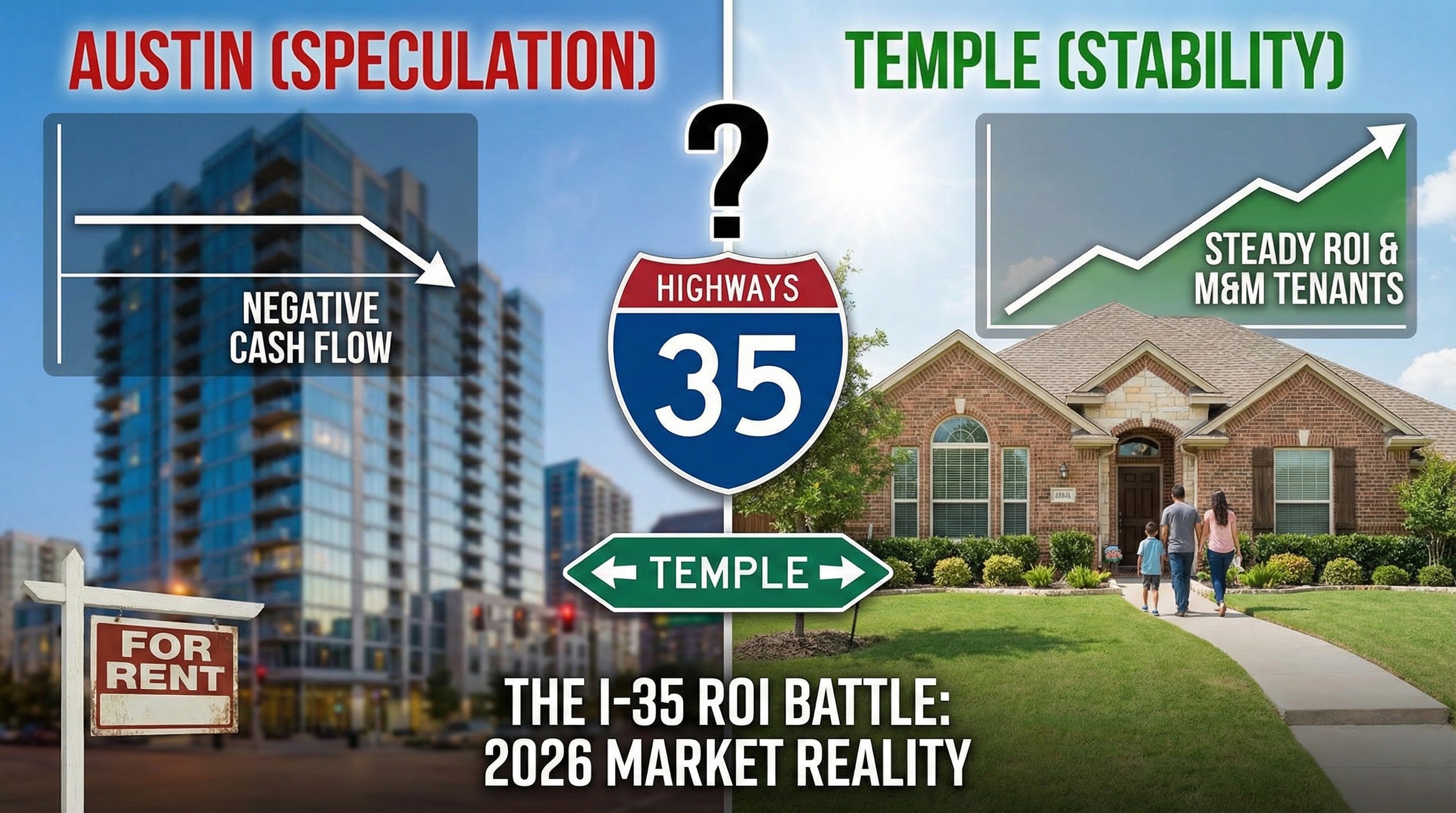
LTR Cash Flow Is Negative at Current Rates
Be honest with your underwriting. A $240K property at 7% interest, 25% down ($180K loan), renting at $1,750/mo produces roughly $1,198/mo in P&I + $414/mo taxes + $160/mo insurance + $175/mo PM fee = $1,947/mo total PITI+PM. That’s a negative $197/month on a long-term rental. The play right now is either (a) mid-term rental near BSW at $2,200–2,800/mo to flip positive, (b) buy below market via off-market or distressed, or (c) accept negative cash flow for appreciation and equity build. Know your strategy before you deploy capital.
Which Temple TX Zip Codes Should Remote Investors Target?
Not all Temple zip codes perform the same. Your strategy dictates your zip. Here is the current breakdown as of Q1 2026, with price ranges, rent expectations, and strategy fit for each area.
| Zip Code | Area Profile | Price Range | LTR Rent (3BR) | Best Strategy | Key Notes |
|---|---|---|---|---|---|
| 76501 | Historic / Central Temple | $140K–220K | $1,300–1,550 | Cash flow / BRRRR | Lowest entry. Older homes — foundation risk higher. Best cash-on-cash if you buy right. Check foundations carefully. |
| 76502 | BSW Corridor / Premium | $240K–340K | $1,700–1,900 | MTR / BSW tenants | Power zip. Travel nurse MTR at $2,200–2,800/mo. Premium tenants, premium entry. |
| 76504 | Military / South Temple | $200K–280K | $1,550–1,750 | Military LTR / Balanced | Closest to Fort Cavazos gates. BAH-backed tenants (E-5: $1,695, E-7: $2,070). Steady demand from PCS rotations. |
| 76513 | Belton / Schools | $250K–350K | $1,750–2,000 | Appreciation / Family LTR | Belton ISD schools drive family demand. Newer builds, lower maintenance. Highest appreciation potential, lowest cash flow. |
For most first-time remote investors, 76502 with an MTR strategy or 76504 with a military LTR strategy offers the best risk-adjusted return. Avoid 76501 unless you have reliable contractor relationships in place — BRRRR rehabs require boots-on-ground oversight that’s harder to manage remotely.
How Much Does It Cost to Close on an Investment Property Remotely?
On a $240,000 investment property in Temple TX, here is the complete closing cost breakdown including remote-specific fees. These numbers reflect actual Bell County title rates and March 2026 lender fees.
| Cost Item | Amount | Notes |
|---|---|---|
| Loan Origination (1%) | $2,400 | May be lower with DSCR lenders |
| Appraisal | $450–600 | Investment property appraisals run higher |
| Title Insurance (Owner’s) | $1,580 | Texas rates are regulated — same at every title company |
| Title Insurance (Lender’s) | $240 | Required by lender |
| Escrow / Title Fees | $650–900 | Title company settlement fees |
| Survey | $400–500 | Required unless recent survey on file |
| Recording Fees | $75–125 | Bell County recorder’s office |
| Prepaid Insurance (12 mo) | $1,920 | DP-3 landlord policy (~$160/mo for LTR) |
| Prepaid Property Tax (prorated) | $1,200–2,400 | Depends on closing month; 2.07% effective rate |
| Remote Online Notarization (RON) | $75–150 | Per-session fee; Texas-approved platform required |
| Option Fee (non-refundable) | $200–500 | Credited to purchase price at closing |
| Home Inspection | $400–550 | General + foundation recommended |
| Total Estimated Closing | $9,590–$10,245 | 3.9–4.3% of purchase price |
Add your down payment ($48,000–60,000 for 20–25% down) and you’re looking at $57,590–$70,245 total capital required to close a $240K investment property remotely in Temple TX. Budget an additional $3,000–5,000 as a post-close reserve for immediate repairs or tenant-readiness improvements.
What Are the Biggest Mistakes Remote Investors Make in Temple TX?
After closing 100+ deals with investors in 14 states, these are the five mistakes that cost remote buyers the most money. Every one of these has happened to a real client — or would have, if we hadn’t caught it.
Skipping the Foundation Inspection on Pre-2005 Homes
Temple sits on expansive clay soil that swells when wet and cracks when dry. Foundation repair in Temple runs $5,000–$25,000+ depending on severity, pier count, and access. Slab foundations on poorly prepped lots are the most common problem. Homes with poor drainage, missing gutters, or mature trees near the foundation line are highest risk. For any property built before 2005, always order a separate structural engineer inspection ($300–500) in addition to your general home inspection. This is not optional for remote buyers — you cannot see hairline cracks on a video walkthrough.
Underestimating Insurance: DP-3 Policy + Hail Deductible
Texas landlord insurance (DP-3 policy) runs $1,700–3,000/year for a single-family rental — roughly $160/month for LTR, $175+ for MTR with contents coverage. But the real trap is the hail deductible. Most Texas policies carry a 1–2% wind/hail deductible, meaning on a $240K property, you’re paying the first $2,400–$4,800 out of pocket on any hail claim. Wind and hail account for 90%+ of Texas property claims. Get quotes during your option period, not after. And budget $4,000+ as a hail reserve in your operating account.
Using the Seller’s Tax Rate in Your Underwriting
Texas has no state income tax but high property taxes. The effective rate in Temple is 2.07% — but the tax bill you see on the MLS listing is the seller’s rate, which may reflect a homestead exemption (saving $1,000–2,000/year) that you don’t qualify for as an investor. On a $240K property, your actual tax bill will be approximately $4,968/year — not the $3,200 you might see listed. That $1,768 difference turns a break-even deal into a money-loser. Always underwrite at the full 2.07% non-homestead rate.
Choosing a PM Based on Fee Instead of Investor Focus
Property management fees in Temple run 8–10% of monthly rent plus one month’s rent for tenant placement. The cheapest PM is almost never the best. What matters for remote investors: response time to maintenance requests, quality of move-in/move-out documentation (photos + video), transparency of monthly reporting, and willingness to manage MTR turnovers if that’s your strategy. Ask every PM candidate: “How many out-of-state investor clients do you manage?” If the answer is under 20, keep looking.
Mismatching Zip Code to Strategy
Buying a $320K new build in 76513 (Belton) and trying to cash-flow it as an LTR will fail. The rent won’t cover PITI at current rates. Conversely, buying a $160K fixer in 76501 for MTR won’t work because travel nurses want newer, furnished homes near BSW — not historic district renovations 15 minutes away. Match your zip to your strategy: MTR goes to 76502, military LTR goes to 76504, BRRRR goes to 76501 (with contractor oversight), and appreciation plays go to 76513.
How Do I Build a Reliable Local Team in Temple TX?
Your local team is your competitive advantage as a remote investor. You are not buying a property — you are buying a team’s ability to execute. Here are the five roles you need filled before submitting your first offer.
1. Investor-Focused Agent
Not every agent understands investment underwriting. You need an agent who can run rental comps (not just sale comps), analyze cap rates, identify off-market opportunities, and provide video walkthroughs on your timeline. They should know which zip codes pencil for which strategy and be willing to tell you when a deal doesn’t work.
2. Property Manager
Temple PM companies include ProManage, Shine Residential Management, Central Texas Castles, Real Property Management Talent, and Rely Property Management. Expect 8–10% of monthly rent + tenant placement fee. Interview at least three. Ask about their maintenance call threshold, monthly reporting format, and experience with travel nurse tenants if MTR is your strategy.
3. Home Inspector (+ Foundation Specialist)
General inspection runs $400–550. Add a separate structural engineer for foundation evaluation ($300–500) on any pre-2005 home. Your inspector should photograph and annotate every finding for remote review. Ask for a video walkthrough of major findings.

4. Insurance Broker
Use an independent broker — not a captive agent — who can shop multiple carriers for your DP-3 policy. Texas insurance is volatile; carriers exit and enter the market frequently. Your broker should quote during the option period so you have real numbers before committing. Specifically ask about wind/hail deductible structure and MTR endorsement options.
5. Title Company
Choose a title company experienced with RON closings and out-of-state investor transactions. Texas title insurance rates are state-regulated (same price everywhere), so selection is about service quality: responsiveness, clear communication with your lender, and smooth RON execution. The notary must be physically located in Texas during the session per state law.
What Does Property Management Look Like Day-to-Day?
For remote investors, your property manager is your eyes, ears, and boots on the ground. Here’s what the operational reality looks like once you close and hand over the keys.
Fee Structure (Temple TX, March 2026)
| Service | Typical Fee | Notes |
|---|---|---|
| Monthly Management | 8–10% | Percentage of collected rent |
| Tenant Placement | 50–100% of 1 mo rent | One-time fee per placement |
| Lease Renewal | $150–300 | Some PMs include in management fee |
| Maintenance Markup | 0–15% | Ask upfront; varies by company |
| Eviction Coordination | $300–500 | Plus attorney/court costs if applicable |
LTR vs. MTR Management: Different Operational Models
Long-term rental management is relatively passive: monthly rent collection, quarterly property checks, annual lease renewal, and maintenance dispatch. A well-placed LTR tenant in Temple averages 18–24 months of occupancy, particularly military families on 2–3 year PCS assignments.
Mid-term rental management is operationally heavier. Furnished units require turnover every 3–6 months: professional cleaning ($150–250), linen/supply refresh, listing updates on Furnished Finder and Airbnb, and coordinated check-in/check-out. Most Temple PMs charge a premium for MTR — expect 12–15% vs. 8–10% for LTR. The upside: BSW travel nurse MTRs can rent at $2,200–2,800/month on a unit that would only fetch $1,750 as an LTR. That $450–1,050/month premium more than covers the additional management cost.
Set a maintenance authorization threshold with your PM — typically $300–500. Anything below that amount, the PM handles without calling you. Anything above requires your approval. This protects you from surprise $3,000 HVAC bills while letting your PM respond quickly to routine issues like a leaking faucet or broken garbage disposal.
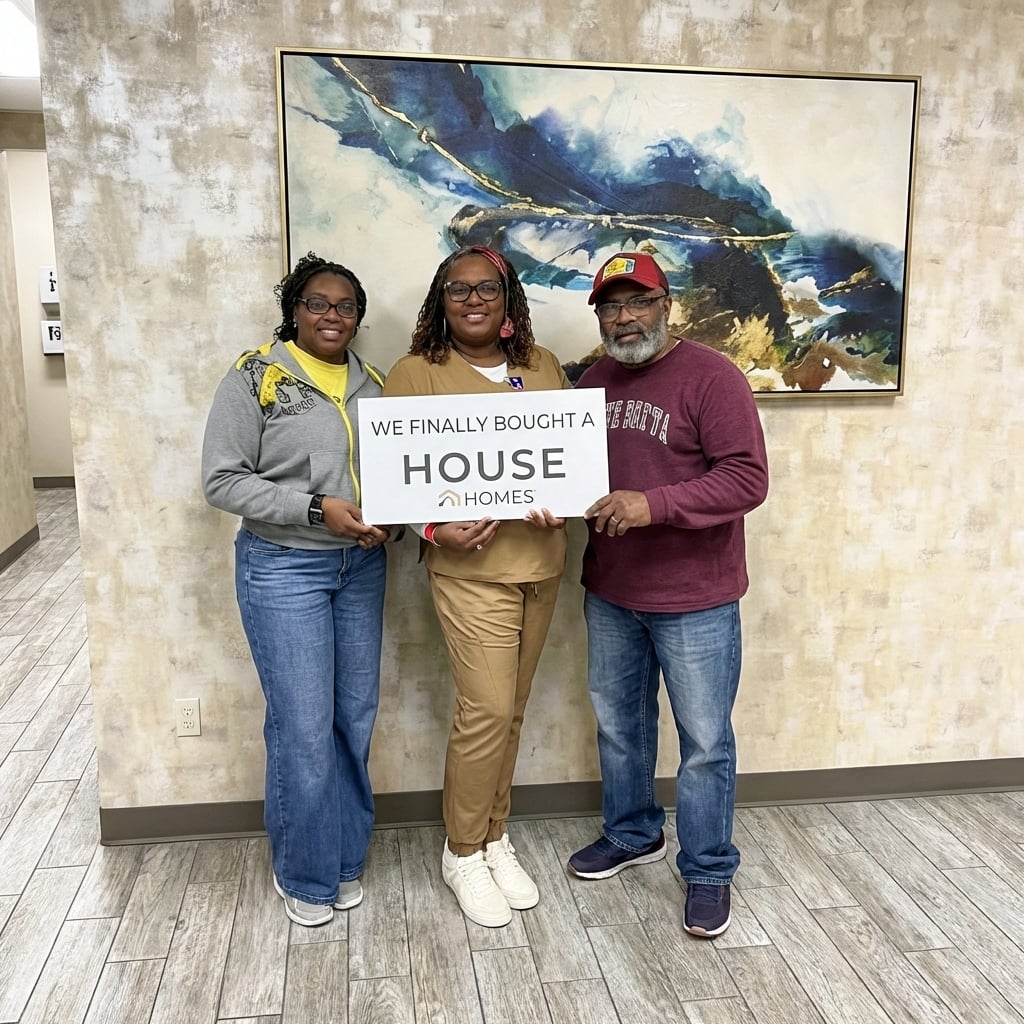
Sedric & Kim closing on a Stylecraft new build in Temple — remote investors benefit from the same builder warranty protections.
“I close deals for investors in 14 states. The ones who succeed remotely all have one thing in common — they trust the process more than their gut.”
I’ll be straight with you: long-term rental cash flow in Temple is negative right now if you’re financing at current rates. I tell every new investor that before they wire earnest money. The math doesn’t lie. A $240K property at 7% interest with a $1,750 rent is underwater by about $200/month after taxes, insurance, and PM fees. That’s the reality of Q1 2026.
So why are my investors still buying? Three reasons. First, mid-term rental strategy near BSW flips the cash flow positive immediately — I have clients netting $400–700/month on furnished units pulling $2,400–2,800 from travel nurses. Third, the investors buying now are positioning for a rate environment that will eventually normalize — when 7% becomes 5.5%, that $200/month loss becomes $150/month profit without touching the rent.
The remote investors who struggle are the ones who skip the option period inspection to “move fast,” pick a PM based on the lowest fee, or buy in 76501 without a contractor they trust. I’ve seen a $14,000 foundation repair bill kill a deal that looked perfect on paper. I’ve seen a $50/month PM savings cost an investor $6,000 in deferred maintenance because the cheap PM wasn’t doing quarterly inspections.
My advice: deploy capital where the data supports it, build your team before you build your portfolio, and don’t let a spreadsheet convince you that a zip code is right when the strategy doesn’t match. I’d rather talk you out of a bad deal than close an easy commission.
Want to underwrite a specific deal together?Text me directly → 254-718-4249
Frequently Asked Questions: Remote Investing in Temple TX
Do I need to visit Temple TX before buying an investment property?
No. Over 60% of investor transactions in Temple close without the buyer visiting in person. Texas’s Remote Online Notarization law allows you to sign all closing documents via secure video conference. Your local agent provides video walkthroughs, your inspector documents everything photographically, and your property manager handles keys at closing. That said, if you’re deploying $200K+ for the first time, a one-day visit to meet your team face-to-face can build confidence — it’s just not required.
What is Remote Online Notarization (RON) and how does it work in Texas?
RON allows you to notarize real estate closing documents via a live video call with a Texas-commissioned notary. Texas legalized RON in 2018 under Government Code Chapter 406. The notary must be physically in Texas; you can be anywhere. Identity verification uses knowledge-based authentication and credential analysis. Sessions are recorded and retained for five years. RON adds $75–150 per session to your closing costs. As of January 2026, notaries must complete mandatory education under SB 693.
Can I buy investment property in an LLC in Texas?
Yes. Texas LLC formation costs $300 with no annual franchise tax for entities under $2.47M in revenue. DSCR lenders commonly close in LLC name directly. Conventional lenders typically require personal name on title — you can quitclaim to your LLC post-close, but this technically triggers the due-on-sale clause (rarely enforced). For maximum asset protection, consult a Texas real estate attorney about series LLC structures, which allow multiple properties under one umbrella entity.
What are DSCR loan requirements for Temple TX investment property?
DSCR loans qualify based on the property’s rental income relative to its debt service — no W-2 or tax returns required. As of March 2026, rates range from 6.1–8.75% depending on DSCR ratio, LTV, and credit score. Most lenders require a minimum DSCR of 1.0–1.25, a credit score of 640–680 (700+ for best rates), 20–25% down payment, and 3–12 months of PITI reserves. Lenders typically use 75% of gross rental income for their DSCR calculation to account for vacancy.
How long does the eviction process take in Texas in 2026?
Under SB 38 (effective January 1, 2026), Texas evictions move faster than nearly any other state. Landlords must provide a minimum 3-day notice to vacate. Trial dates are set within 10–21 days of filing. For unauthorized occupants with no lease, judgment can come in as few as five days. Tenants who appeal must post one month’s rent into court escrow and affirm a meritorious defense under penalty of perjury. The total timeline from notice to possession typically runs 21–45 days, compared to 60–90+ days in tenant-friendly states like California.
What is the property tax rate on investment property in Temple TX?
The effective property tax rate in Temple TX is 2.07%. On a $240,000 investment property, that equals $4,968 per year ($414/month). Critical note for remote investors: MLS listings often show the seller’s tax amount, which may include a homestead exemption reducing the bill by $1,000–2,000/year. As an investor, you do not qualify for homestead exemption. Always underwrite at the full 2.07% rate to avoid surprises.
How much does property management cost in Temple TX?
Property management in Temple TX typically costs 8–10% of monthly collected rent for long-term rentals, plus a tenant placement fee of 50–100% of one month’s rent. Mid-term rental management runs 12–15% due to higher turnover and furnished unit maintenance. On a $1,750/month LTR, expect $140–175/month in management fees. Local PM companies serving investors include ProManage, Shine Residential, Real Property Management Talent, and Rely Property Management.
Is Temple TX a good market for mid-term rentals and travel nurses?
Yes. Baylor Scott & White Medical Center — Temple employs 8,800+ workers and consistently recruits travel nurses, locum physicians, and contract staff. Furnished 3BR units in 76502 near BSW rent for $2,200–2,800/month on 3–6 month leases — a 30–60% premium over long-term rental rates. MTR is the primary strategy that produces positive cash flow in Temple at current interest rates. Furnished Finder is the dominant platform for Temple’s travel nurse market.
What are the biggest risks of buying rental property in Temple TX?
The top three risks are foundation damage from Temple’s expansive clay soil (repair costs $5,000–25,000+), high insurance costs with 1–2% hail deductibles ($2,400–4,800 out-of-pocket per hail claim on a $240K property), and negative LTR cash flow at current 7%+ interest rates. Secondary risks include property tax reassessment after purchase (losing the seller’s homestead exemption) and HOA rental restrictions in certain newer subdivisions. These risks are manageable with proper due diligence but cannot be ignored in your underwriting.
What is the Fort Cavazos BAH rate and how does it affect Temple TX rentals?
2026 Fort Cavazos BAH rates: E-5 with dependents receives $1,695/month, E-7 with dependents receives $2,070/month. BAH is a tax-free housing allowance that effectively guarantees rent payment for military tenants. For remote investors targeting military families in 76504, BAH-backed tenants are among the most reliable in the country — the allowance deposits directly and consistently. A 3BR home priced at $1,650–1,750/month aligns perfectly with E-5/E-6 BAH budgets, ensuring strong demand and minimal vacancy between PCS cycles.
Ready to Deploy Capital in Temple TX?
Whether you’re buying your first rental or scaling a portfolio across state lines, the process starts with a 15-minute call to define your buy box and strategy.

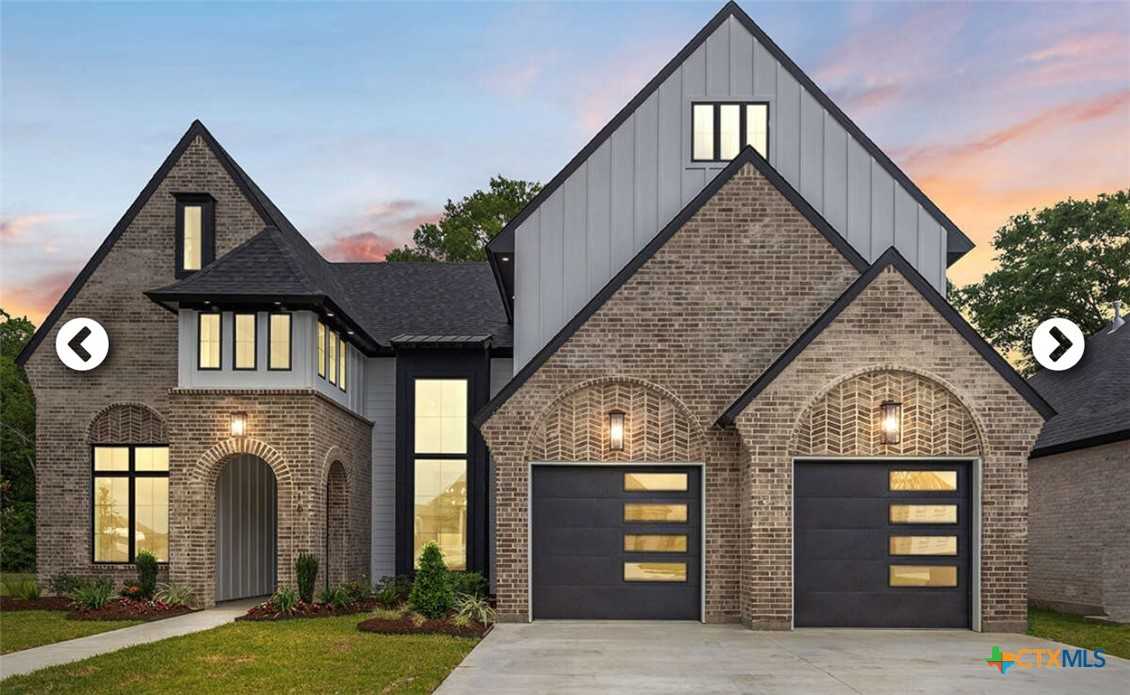
New construction in the Temple-Belton corridor offers remote investors builder warranties and lower maintenance costs in the critical first years of ownership.