Living in Harker Heights, TX
The Fort Hood corridor’s established city — the most house per dollar on the board — and the one town in the metro that finished building before the boom, which changes everything about how you shop it.
Harker Heights is the Fort Hood corridor’s established bedroom city: roughly 33,000 people, Killeen ISD schools, and 12–18 minutes to the base’s east gates. Homes run a $315,000 median at $140 per square foot — a lower price per square foot than the compared cities in the August snapshot. The trade: almost no new construction, and a sticker about $75K above Killeen.
Is Harker Heights just a suburb of Killeen?
Legally, no — and practically, that “no” is worth real money. Harker Heights is its own incorporated city in Bell County with its own police department, its own tax rate, and its own code enforcement, sitting directly east of Killeen along I-14/US-190 with Fort Hood on its northwest shoulder and Stillhouse Hollow Lake as its entire southern boundary. You will not see a gap when you drive from Killeen into Harker Heights — the two cities share a street grid, a school district, and a labor market. What changes at the line is the housing stock, the median income, and the way the city is run.
Harker Heights developed primarily from the 1980s through the 2010s on wooded, rolling terrain south of I-14. Most buildable land is now filled, so the housing stock skews larger and older than nearby new-construction corridors. Compare the city on measurable factors — price per square foot, commute time, lot size, tax rate, and the condition of each property — rather than assumptions about who lives there.
Harker Heights is functionally built out. Only 3 of the 137 homes on the market were built in 2025 or later, against 110 in Killeen and 46 in Nolanville next door. In every other corridor city you’re choosing between resale and new construction. In Harker Heights the new-build option barely exists, which limits supply and shifts the comparison toward established resale homes.
How much does a house in Harker Heights cost in 2026?
The median asking price across all 137 current listings is $315,000 at $140 per square foot, and the median home on the market is a 2,252 sq ft 4-bedroom. Over the last month, 21 homes closed at a median $329,900 — 99.5% of asking. Here’s the full board, from one 8/30/2026 CTXMLS pull, so you’re comparing apples to apples:
| City | For sale | Median list | $/sq ft | Median DOM | Built 2025+ |
|---|---|---|---|---|---|
| Killeen | 719 | $240,000 | $138 | 59 | 110 |
| Temple | 641 | $285,000 | $162 | 74 | 142 |
| Harker Heights | 137 | $315,000 | $140 | 60 | 3 |
| Belton | 251 | $344,500 | $178 | 72 | 64 |
| Nolanville | 79 | $353,190 | $183 | 56 | 46 |
| Salado | 105 | $635,000 | $239 | 96 | 37 |
Active listings by city, single 8/30/2026 CTXMLS pull. Medians move — treat as a snapshot, not a quote.
Read the middle column against the $/sq ft column and the Harker Heights position jumps out: it prices above Killeen and Temple on sticker, but per square foot it’s within $2 of Killeen — the cheapest space in the corridor’s upper tier. You’re not paying a premium for the address; you’re buying more house.
Where the 137 listings actually sit
The sweet spot is $250K–$400K: 91 of 137 listings. The floor is a $74,900 project house; the ceiling is $1.45M near the lake.
How fast priced-right homes went in August’s closings — several at or above full asking. A Comanche Gap Estates home took $349,000 (100% of list) in 5 days; a Highland Oaks listing closed at 102.1% of asking in 17.
Listings sitting over 120 days. This is a two-speed market: correct pricing moves in under three weeks, wishful pricing sits for a season. The 99.5%-of-ask median only applies to homes priced at the market to begin with.
Anchoring on the wrong comp. Because inventory splits between well-kept 1990s Skipcha homes and 2015+ Tuscany Meadows stock, a “3-bed in Harker Heights” can honestly comp anywhere from $217K to $430K. Sellers anchor on the new end; the 30 stale listings above are mostly that mistake. Get the subdivision-level comp before you write anything.
What the same $315,000 buys in Harker Heights versus Belton at current per-square-foot medians — about 2,250 sq ft here against roughly 1,770 there. Against Temple the gap is ~306 sq ft; against Nolanville, ~529.
$315,000 ÷ $140/sq ft vs ÷ $162 (Temple), $178 (Belton), $183 (Nolanville) · CTXMLS 8/30/2026What does your budget buy, city by city?
Drag the budget. Square footage is your budget divided by each city’s current median $/sq ft — a planning gauge, not a quote for any specific house.
Median list $/sq ft per city, CTXMLS 8/30/2026. Condition, lot, and age move any single house well off these medians.
What are the best neighborhoods in Harker Heights?
There is no universal “best” neighborhood. Harker Heights subdivisions differ mainly by build era, lot size, housing type, price, and proximity to major routes. Every figure below comes from the same 8/30/2026 pull — active listings in each subdivision family, all phases combined.
Skipcha Mountain Estates
Largest share of sampled active inventory 36 active · median $311,500 · $225K–$409K · ~2,326 sq ft · built 1988–2011Housing profile: brick homes, mature trees, larger lots, and no HOA in the sampled listings.
The city’s signature neighborhood and its deepest market: more than one in four Harker Heights listings is a Skipcha address. Older phases (“old Skipcha”) run larger lots and 1990s builds; later phases push into the 2000s. Because so much inventory concentrates here, it’s also where correct pricing is easiest to prove — and where overpriced listings get exposed fastest.
Tuscany Meadows
The big-house tier, 2013–2018 8 active · median $377,500 · $315K–$430K · ~3,169 sq ftHousing profile: the largest median square footage in this city snapshot and a lower per-foot price than the compared Belton inventory.
The closest thing Harker Heights has to “newer construction” at scale. An August closing here went at 100.8% of asking — this tier moves when priced right.
Cedarbrook Ridge
The newest pocket — and the HOA exception 8 active · median $382,000 · $265K–$453K · ~2,617 sq ft · built 2018–2022Housing profile: newer build years within Harker Heights, with the location and inventory tradeoffs noted below.
Here’s the quirk: most of Harker Heights has no HOA — only 12 of the city’s 137 listings report one, and 8 of those 12 are Cedarbrook Ridge. If avoiding an HOA matters to you, this is the pocket to screen; if you want newer-build uniformity, it’s the pocket to target.
Highland Oaks Estates
Mid-century lots, modern spread 6 active · median $310,000 · $215K–$539K · built 1964–1977Housing profile: older homes on some of the city’s larger parcels, with a wide price range and potential renovation needs.
1960s–70s bones mean real trees and real yards, and August proved the demand: one Highland Oaks sale closed at 102.1% of asking in 17 days.
Tanglewood North
The entry tier 10 active · median $262,450 · $217K–$295K · ~1,850 sq ft · built 1977–2006Housing profile: the lowest median entry price among the six subdivision groups in this snapshot.
The most accessible established neighborhood in the city — and with ten listings up, the entry tier currently has real selection.
Broken Arrow Lake Estates & the lake edge
South-side, closest to Stillhouse 4 active · median $277,450 · $250K–$330K · built 1971–2006Housing profile: a south-side location with the shortest drive of these groups to Dana Peak Park and Stillhouse Hollow Lake.
South Harker Heights toward the lake is the part of town locals bring up first — hillier, greener, quieter. The upper end of the city’s market ($500K–$1.45M) also clusters south: Evergreen (3 active, median $425K, builds to 2024) carries the newest custom stock.
Smaller pockets with current listings: The Vineyard (2 active, ~$248K), Savannah Heights (2 active, ~$283K), Sutton-area streets (3 active, ~$379K), Stagecoach Valley, and Meadow Acres — the city’s oldest section, where the $74,900 floor listing lives alongside renovated homes at triple that. Local buyer groups also consistently name Doc Whitten Estates and Knights Ridge as favorite quiet pockets, though neither had a listing on the board at this pull.
The no-HOA norm is a genuine Harker Heights differentiator. In Killeen’s and Nolanville’s newer subdivisions, an HOA (and often a PID) is standard. Here, 125 of 137 current listings report none — no dues, no architecture committee, and also no one to stop your neighbor’s boat parked curbside. Decide which side of that trade you’re on before you pick a street.
What do the current school ratings show?
Harker Heights is served by Killeen ISD, which received a C (79) in the August 2026 TEA accountability release. Campus results vary, so district-wide and individual-campus ratings should be reviewed separately rather than used as a neighborhood recommendation.
Harker Heights High School earned an A (92) in the 2026 TEA ratings — up from a B (86) in 2025 — making it one of five A-rated campuses in Killeen ISD. The table below lists the latest published ratings for campuses with Harker Heights addresses.
| Campus | Enrollment | 2025 TEA | 2026 TEA |
|---|---|---|---|
| Harker Heights High School | 2,175 | B (86) | A (92) |
| Union Grove Middle School | 718 | C | C (up 7 points) |
| Eastern Hills Middle School | 542 | F (58) | D (66) |
| Harker Heights Elementary | 678 | B | — |
| Skipcha Elementary | 885 | B | — |
| Mountain View Elementary | 771 | C | — |
TEA A–F accountability ratings; 2026 released 8/14/2026 (elementary 2026 grades pending at txschools.gov — 2025 shown). Killeen ISD district: C (79) in 2026.
Published ratings vary by campus: Harker Heights High received A (92), Union Grove received C, and Eastern Hills received D (66); the elementary scores shown are the latest available. Belton ISD and Salado ISD both received B district ratings. Verify the exact assigned campus for any address and review current TEA data rather than using a district label to choose a neighborhood.
When Killeen ISD opened Chaparral High School, it redrew all four high-school attendance zones — some south and southwest Harker Heights addresses now zone away from Harker Heights High. Never assume the campus from the neighborhood name: verify the exact address against KISD’s current attendance-zone maps before you write an offer. Killeen ISD also accepts in-district transfer requests each spring; the window closes in early April.
What’s the commute from Harker Heights to Fort Hood really like?
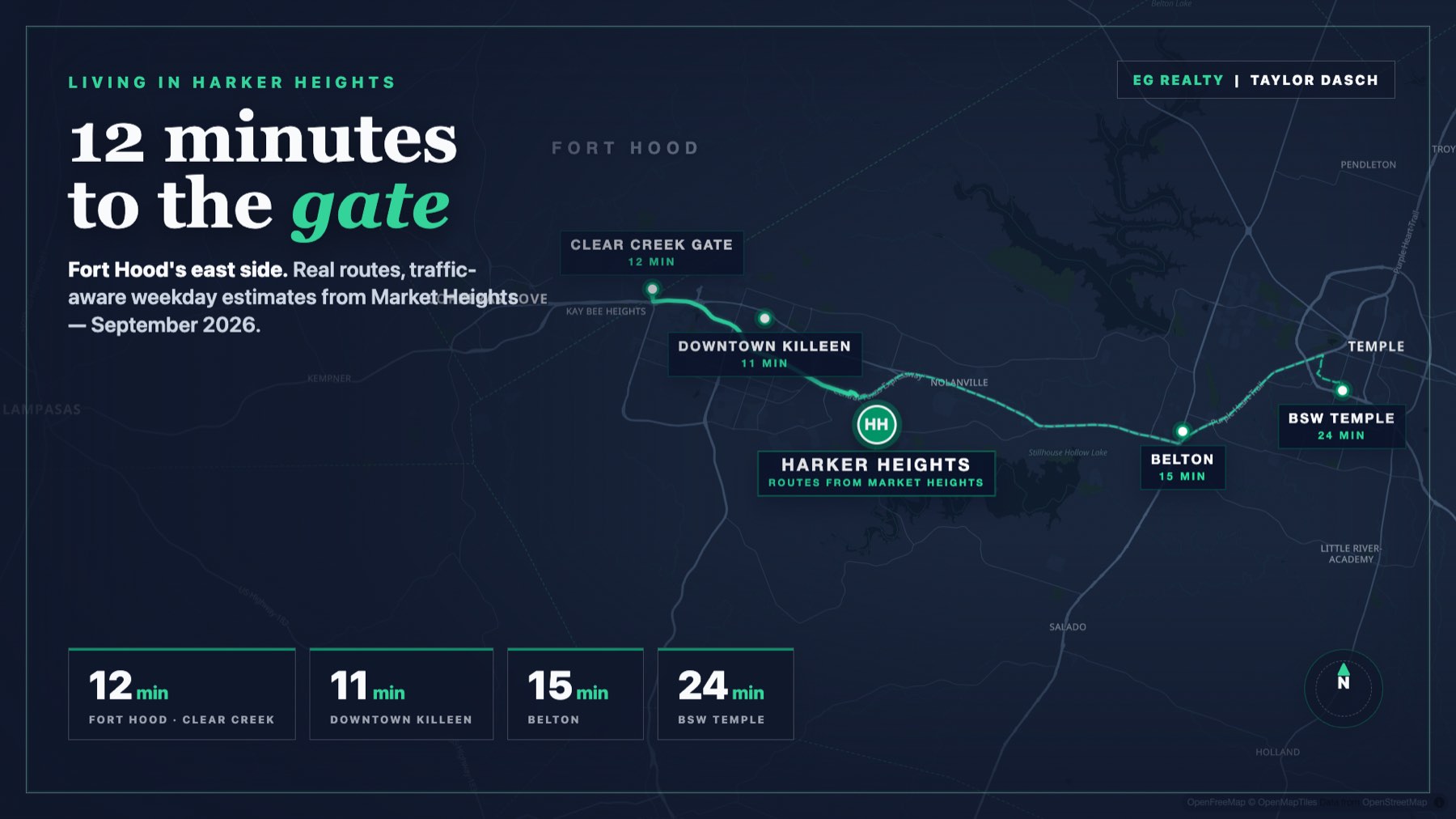
Harker Heights sits on the east side of the base, so the relevant gates are Fort Hood’s east and southeast entrances — not the main gate traffic most “10 minutes to post” claims quietly ignore. Midday, traffic-checked numbers from the city’s center (Market Heights) and from deep in Skipcha:
| Destination | From city center | From Skipcha |
|---|---|---|
| Fort Hood — Clear Creek Gate | ~12 min | ~18 min |
| Downtown Killeen | ~11 min | ~17 min |
| Belton | ~15 min | ~20 min |
| Killeen–Fort Hood Regional Airport | ~20 min | ~21 min |
| BSW Medical Center, Temple | ~24 min | ~28 min |
| Downtown Austin | ~1 hr 21 min | ~1 hr 12 min |
Google traffic-aware estimates, weekday midday, September 2026. Gate wait times not included.
Two honest additions to those numbers. First, PT-hour and 5pm release traffic are real: the 6:30am westbound crawl on I-14 and the surge when soldiers release are the two windows that stretch a 12-minute run toward 25. Second, Harker Heights also supports a two-destination commute — BSW Temple is a 24–28 minute drive while the base’s east gates are closer.
The railroad. A freight line runs parallel to I-14/US-190 through the corridor with no over- or underpasses on the local crossings — when a train rolls at rush hour, the north–south streets stack up and feed the backup onto the highway. If your daily route crosses the tracks, drive it at 7:15am once before you buy. It’s the single most common commute surprise in the corridor.
Military rank is not a housing criterion. From Harker Heights, midday drives to Clear Creek Gate are roughly 12 minutes from the city center and 18 minutes from Skipcha; Georgetown, Liberty Hill, and Cedar Park usually add substantial time. Compare the actual gate, shift, housing allowance, property condition, and total monthly cost. Run the payment side with the Fort Hood BAH calculator.
How high are property taxes and water bills in Harker Heights?
This is where the local folklore is flat wrong. Ask around the corridor and you’ll hear that Harker Heights taxes are high. The official Bell CAD 2025 rate table says the opposite: Harker Heights carries the lowest total property-tax stack of the four cities, because it pairs a modest city rate with Killeen ISD’s unusually low school rate.
| Layer (2025 tax year, per $100) | Harker Heights | Killeen | Temple | Belton |
|---|---|---|---|---|
| City | $0.5300 | $0.7014 | $0.6999 | $0.5225 |
| School district | KISD $0.8778 | KISD $0.8778 | Temple ISD $1.1372 | Belton ISD $1.1494 |
| Bell County + road district | $0.3327 | $0.3327 | $0.3327 | $0.3327 |
| College + water district | $0.0922 | $0.0922 | $0.2178 | $0.0022 |
| Total | ≈$1.833 | ≈$2.004 | ≈$2.388 | ≈$2.007 |
Bell CAD official 2025 tax-rate table (9/30/2025). Temple’s college+water line includes Temple College and the Health & Bioscience district; exemptions differ by city. 2026 rates finalize in September 2026 — Harker Heights has proposed 54.72¢ city (vs 53¢) — verify current rates before budgeting.
On a $350,000 homesteaded home under 2025 rules, that works out to roughly $5,200 a year in Harker Heights against about $6,100 in Temple, with Killeen and Belton in between — the state’s $140K school-district homestead exemption does a lot of the work, and Killeen ISD’s $0.8778 school rate (versus $1.14+ in Temple ISD and Belton ISD) does the rest. Run any specific parcel before you rely on it: exemptions and small district layers move the answer.
Harker Heights deliberately buys its property-tax rate down with sales tax. The Bell CAD table itself footnotes a $0.126-per-$100 sales-tax adjustment for the city — Market Heights and the Knights Way retail corridor generate the revenue, and homeowners keep a lower rate. Every time the metro shops at that Cinemark, Harker Heights property owners win a little.
The water bill, explained
“Harker Heights water bill” gets searched roughly 880 times a month — more than any housing query about the city — so let’s answer it with the actual fee schedule. The city consolidates water + sewer + drainage + trash on one statement, which is why the number reads big. Current rates (FY 2025–26): water $13.52 base plus $4.22 per 1,000 gallons; sewer $24.35 base plus $4.08 per 1,000 — capped at 10,000 gallons; drainage $6.00; trash $22.63 with twice-weekly pickup. A typical 5,000-gallon month lands around $96 all-in. The same usage profile on Temple’s current rates runs about $118 — the Harker Heights bill isn’t the corridor’s high one, it’s just consolidated.
- The sewer cap is a quiet win: residential sewer billing stops at 10,000 gallons, so summer lawn watering doesn’t inflate the sewer line.
- Twice-weekly trash — most metro neighbors run weekly. The trade: no curbside recycling; the city drop center at 1761 FM 2410 covers it (every account pays a $2/month drop-site fee).
- Where the water comes from: Bell County WCID No. 1, which treats water drawn from Belton Lake and Stillhouse Hollow Lake for the whole corridor, including Fort Hood.
- New-account setup and bill pay run through the city’s utility office at harkerheights.gov.
How should buyers compare public-safety data for Harker Heights and Killeen?
The available sources are not directly comparable because they use different reporting years, populations, and definitions. Aggregated NIBRS-based trackers estimate Harker Heights at roughly 135 violent crimes per 100,000 residents and property crime about 44% below the national average. Killeen Police reported 18 murders and 589 aggravated assaults in 2025; Harker Heights Police reported 4 murders in its 2023 annual report and burglaries down 45% to 38 for that year. Treat each figure as source-specific context, not a citywide verdict.
Harker Heights Police also reported that 66% of its 2025 traffic stops involved non-residents, but traffic-stop residency is not a measure of neighborhood safety. For a specific property, review the latest police reports and address-level public crime maps, visit at different times, and evaluate the block rather than relying on a city ranking or an informal rule of thumb.
Killeen’s 2025 report and Harker Heights’ latest annual report cover different periods and populations. Use them as context, not a “safe city versus dangerous city” verdict or a reason to steer toward one side of the city line. The measurable housing difference in this snapshot is a roughly $75,000 median-list-price gap.
What is living in Harker Heights actually like day to day?
It’s a bedroom city, and it doesn’t pretend otherwise. The residents’ own most common complaint is that it can get boring — the entertainment options are restaurants, the Cinemark, and whatever Killeen and Temple are doing. If you need a downtown, this isn’t it. What it has instead is the most complete daily-errand loop in the corridor packed into 15.6 square miles:
- Market Heights — the metro’s ~412,000 sq ft power center: Cinemark, Dick’s Sporting Goods, Barnes & Noble, Ross, Old Navy, Ulta, with Target anchoring the corner and the Chick-fil-A/Cheddar’s/Cracker Barrel outparcel row. The corridor’s retail gravity sits inside Harker Heights city limits — which, per the tax chapter, is exactly why the city’s tax rate stays down.
- H-E-B at 601 Indian Trail — the city’s own full store with curbside and pharmacy. (Pedantic local note: the giant H-E-B plus! everyone mentions is technically across the line on Trimmier in Killeen, eight minutes away.)
- Seton Medical Center Harker Heights — an 83-bed acute-care hospital with a Level IV trauma ER inside city limits, open since 2012. You have a full hospital in town before the 25-minute drive to Baylor Scott & White in Temple ever comes up.
- Dana Peak Park on Stillhouse Hollow Lake — the ~560-acre Army Corps park off Comanche Gap Road: swim beach, boat ramps, RV and tent camping, and the corridor’s best trail system (the Fence Line/Twin Peaks loop is the local mountain-biking standard). One current-state fact most pages miss: the lake’s only marina closed permanently in 2024 after flood and fire damage — Stillhouse is currently a bring-your-own-boat lake, launch ramps only.
- Carl Levin Park — 35 acres with the community pool ($4 resident day pass), splash pad, amphitheater, a 30-plot community garden, and a fishing pond the city stocks with rainbow trout twice a year. The park is named for a Harker Heights police officer killed in the line of duty in 1978; his memorial stands at the pool entrance.
- Purser Family Park — dual fenced dog parks, a lighted one-mile loop, and disc golf on the city’s west side; Community Park adds eight ball fields and the lighted Kyle Hilliard Trail.
- The calendar’s anchor: the Chamber’s Food, Wine & Brew Festival — 18th annual, October 17, 2026, with Jason Boland & The Stragglers headlining.
The growth story is small-scale by design: the Knights Way/FM 2410 corridor currently carries about $9.4M across six commercial projects (Black Rock Coffee is open; Chicken Salad Chick and others build through 2026). A city that officials have called landlocked since 2012 — boxed by Killeen, Fort Hood, Nolanville, and the lake — plans for a build-out ceiling around 50,000 people. That’s the quiet thesis of this whole page: supply here is capped by geography, and the city knows it.
Local trivia that outlasts every listing: the name is a mash-up honoring developer HARley KERn, who died just before the town’s 1960 incorporation. Official motto: “The Bright Star of Central Texas.”
Who should NOT buy in Harker Heights?
This page is useless if it only recruits. Four buyers who should look elsewhere:
- You want new construction. With 3 of 137 listings built since 2025, the product barely exists here. Shop Nolanville or south Killeen for corridor new-builds, or Temple’s new-construction market if the commute math works.
- You’re maximizing pure price. Killeen’s $240K median beats Harker Heights by $75K, and its per-square-foot cost is nearly identical. If budget is the whole decision, Killeen wins — subdivision by subdivision vetting is the job there.
- Your life points at Temple. If the hospital district, Temple ISD, or I-35 is your daily anchor, Temple saves you 25 minutes a day and offers 641 listings to pick from. See the full Temple vs Killeen breakdown for how the two metros actually differ.
- You want land or lake frontage you own. Harker Heights lots are city lots, and Stillhouse is Corps-managed shoreline — you won’t own the water’s edge. For acreage, look at Salado or rural Belton.

I sell across every city on that comparison table, and Harker Heights presents a distinct property comparison: a 2,300 sq ft 1990s brick home on a treed lot may compete at the same price as a brand-new 1,700 sq ft build elsewhere. On recent back-to-back tour days across Belton, Morgan’s Point, and Harker Heights, the same budget produced materially different square footage, yard size, home age, and condition. Those property facts — along with commute and total monthly cost — are the useful basis for the decision.
My honest read on the market right now: the two-speed split is the whole game. When a Skipcha or Highland Oaks home is priced on the actual subdivision comps, it’s gone in two weeks at full ask — but a third of the board is sitting stale because sellers priced 2026 like 2022. That’s leverage if you’re patient: the 120-day listings are where negotiations actually happen in this city. And one thing I tell every relocating buyer: don’t let the $315K median scare you off the city — the $250K–$300K band is the deepest band on the board, 36 homes right now. The established-city discount per square foot is real, and I don’t think it survives the corridor’s growth long-term.
Living in Harker Heights: the questions people actually ask
Is Harker Heights, TX a good place to live?
Harker Heights offers established housing, a $315,000 median list price at $140 per square foot across 137 current listings, and a roughly 12–18 minute drive to Fort Hood’s east gates. Tradeoffs include very little new construction, a median price about $75,000 above Killeen, and fewer big-city amenities. Whether it fits depends on the buyer’s budget, commute, property-type preference, and address-level due diligence.
How much does a house cost in Harker Heights?
The median asking price is $315,000 at $140 per square foot (137 active listings, CTXMLS 8/30/2026), and the median home offered is a 2,252 sq ft 4-bedroom. Current inventory spans $74,900 to $1.45M, with the deepest band at $250K–$300K (36 listings). Homes that closed in August went at a median 99.5% of asking in 53 days. These numbers move — verify current data before budgeting.
What are the best neighborhoods in Harker Heights?
There is no universal best; compare the housing profile and the specific property. In the 8/30/2026 snapshot, Skipcha Mountain Estates had 36 active listings and a $311,500 median, Tuscany Meadows had the largest median home size, Cedarbrook Ridge had newer build years, Highland Oaks included larger older parcels, Tanglewood North had a $262,450 median, and south-side subdivisions sat closest to Stillhouse Hollow Lake.
Is Harker Heights a suburb of Killeen?
It’s an independent incorporated city in Bell County with its own police department, city government, and tax rate, but it shares Killeen ISD, a street grid, and a labor market with Killeen. Practically: separate city, same metro. Compare housing age and size, municipal services and taxes, commute, and current market behavior.
How should buyers compare public-safety data for Harker Heights and Killeen?
Do not treat the available figures as a direct city ranking because the reports use different years, populations, and definitions. Review each police department’s latest report, check address-level public crime maps, visit the block at different times, and treat third-party rate estimates as source-specific context rather than a neighborhood recommendation.
What is the crime rate in Harker Heights, Texas?
Aggregated NIBRS-derived tracking estimates roughly 135 violent crimes and about 990 property crimes per 100,000 residents. Harker Heights Police reported burglaries down 45% to 38 in its 2023 annual report, while its 2025 traffic-stop report covers a different measure. Verify the latest city report and the specific address; these figures should not be used as a neighborhood safety ranking.
Which school district serves Harker Heights, and where can buyers verify campuses?
Harker Heights is served by Killeen ISD, which received a C (79) in the August 2026 TEA release. Harker Heights High received an A (92), Eastern Hills received D (66), and Union Grove received C; elementary ratings shown on this page are the latest published values available. Verify the assigned campus for the exact address using current KISD attendance-zone maps and review current TEA reports.
Are property taxes high in Harker Heights?
No — by official rates it’s the lowest total stack of the corridor’s four cities. Per the Bell CAD 2025 table: about $1.83 per $100 all-in (city $0.53 + Killeen ISD $0.8778 + county and small districts), versus roughly $2.00 in Killeen, $2.01 in Belton, and $2.39 in Temple. On a $350K homesteaded home that’s approximately $5,200/yr here against $6,100 in Temple. Rates finalize each September — verify the current year before budgeting.
Why is my Harker Heights water bill so high?
Because it isn’t just water: the city bills water, sewer, drainage, and trash on one statement. Current rates (FY 2025–26): water $13.52 base + $4.22/1,000 gallons, sewer $24.35 base + $4.08/1,000 capped at 10,000 gallons, drainage $6, trash $22.63 with twice-weekly pickup — a 5,000-gallon month runs about $96 all-in. The same usage on Temple’s rates runs about $118, so Harker Heights’ consolidated bill is actually the cheaper of the two.
How far is Harker Heights from Fort Hood and Austin?
Fort Hood’s Clear Creek Gate is roughly 12 minutes from the city center and 18 from the Skipcha area (midday estimates; PT-hour and 5pm release windows run longer). Downtown Killeen is 11–17 minutes, Belton 15–20, Baylor Scott & White in Temple 24–28, and downtown Austin about 1 hour 15 minutes via I-35.
Harker Heights vs Belton vs Nolanville — how do they compare?
Harker Heights: $315K median, $140/sq ft, Killeen ISD, 12-minute base commute, built out with almost no new construction. Nolanville: $353K median, $183/sq ft, mostly new-build inventory, no full grocery store in town — and note the district: all 138 Nolanville listings in the 8/30/2026 MLS pull carry Killeen ISD, with students feeding Harker Heights-area campuses; verify the zoned campus for any specific address. Belton: $344.5K median, $178/sq ft, Belton ISD, lake-and-land character, but a 25–35 minute base commute. Pick by commute tolerance and new-vs-established preference.
Does Harker Heights have new construction?
Very little — 3 of 137 current Harker Heights listings were built in 2025 or later. In the same pull, Nolanville had 46, Killeen 110, Temple 142, and Belton 64 new-build listings. Cedarbrook Ridge contained some of the city’s newer established inventory (2018–2022). Buyers requiring a 2025-or-newer home should compare current inventory across the corridor rather than assume availability from the city name.
Want this math run on a specific address? That’s free.
Send me the listing — or just your budget and timeline — and I’ll come back with the subdivision-level comps, the real tax math for that parcel, days-on-market history, and what I’d actually offer. No pressure, no drip campaign.