Relocating to Temple When Only One of You Is the Doctor: A Dual-Career & Housing Plan
Taylor Dasch, real estate agent at EG Realty in Temple, Texas, has $27M+ across 100+ real estate transactions and works with Baylor Scott & White households relocating here. If your partner matched or signed at BSW Temple and you still have a career to move, this is the honest spouse job-market read, the childcare math, and how to pick a home that works for both of you.
If my spouse is starting at Baylor Scott & White Temple, can I move my career here too?
Mostly yes — with one honest caveat. Temple is a mid-size Central Texas metro anchored by healthcare, education, and logistics, so a trailing spouse in those fields usually finds work; specialized careers are thinner, and remote or hybrid work is the most reliable lane. The housing decision should minimize the sum of two commutes — the physician’s fixed drive to the BSW campus and the spouse’s drive to a job or a home office — and childcare availability often decides the neighborhood before school ratings do. The financial lever in your favor is cost: Temple’s median closed home price is $274,315 and median rent is $1,650/mo, well below an Austin-metro base for a remote spouse.
- Strongest local sectors for a spouse: healthcare, education, logistics/distribution; specialized fields are thinner [VERIFY]
- Most reliable lane for a specialized career: remote or hybrid — Temple is a low-cost base for it
- Temple median closed home price: $274,315; median $157/sq ft; 72 days on market (Temple, 3mo, june-18-mls-data.csv)
- Temple median rent: $1,650/mo (rental-data-bell.csv) — useful for a rent-first career bridge
- Pick the neighborhood by the sum of two commutes, not just the physician’s drive to BSW
- Solve childcare before the ZIP code — waitlists and shift-aligned care decide the search for dual-career households
What’s the spouse job market actually like near Temple?
Straight answer: Temple’s job market is strong if you’re in healthcare, education, or logistics, narrower if you’re in a specialized field, and most reliable of all if your role can go remote. It is a mid-size metro, not a major one — so plan for that, scars and all.
Temple sits at the center of a Central Texas corridor with real employers, but it is not Austin. The largest job bases are healthcare, education, and distribution/manufacturing. For a trailing spouse, that means a nurse, teacher, therapist, supply-chain or operations professional has a genuine local market; a niche specialist (think narrow tech, finance, or research roles) will find the local pool thin and should plan around remote work or a commute to a bigger metro.
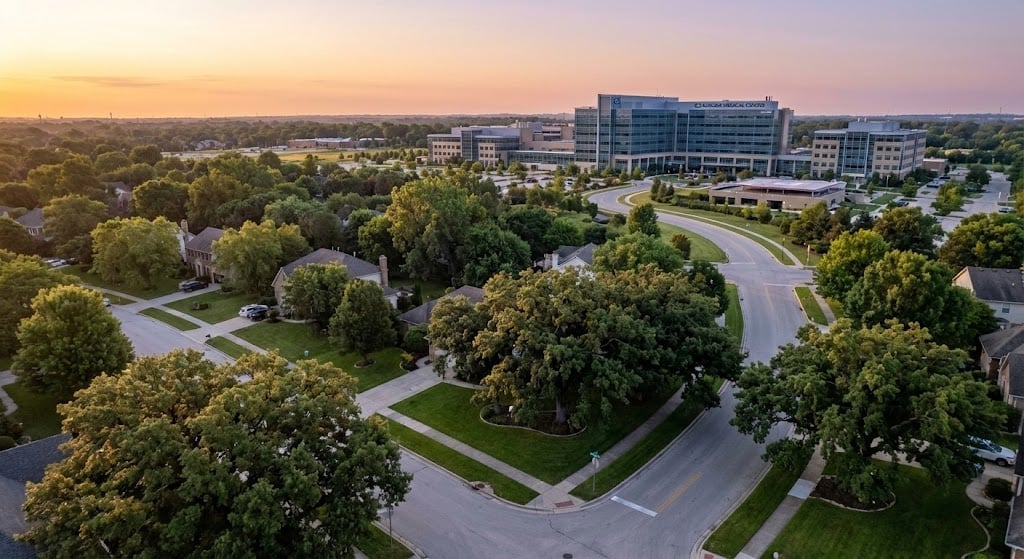
The largest employers worth researching before you move
These are the local anchors a spouse should target or set job alerts on. Treat every headcount and sector size as something to confirm with a fresh source (employer career pages, Texas Workforce Commission, BLS) before you bank on it — none of these counts are verified here:
| Employer | Sector | Spouse-relevant roles |
|---|---|---|
| Baylor Scott & White Health | Healthcare [VERIFY] ~8,884 employees | Clinical, nursing, allied health, admin, research |
| McLane Company | Logistics / distribution [VERIFY] | Supply chain, operations, corporate, tech |
| Temple ISD | Education [VERIFY] | Teaching, counseling, administration, support |
| Wilsonart | Manufacturing [VERIFY] | Engineering, design, ops, sales |
| City of Temple | Government [VERIFY] | Admin, planning, public services |
| Texas A&M Health Science Center | Education / health [VERIFY] | Academic, research, clinical support |
How far can a spouse reasonably commute for work?
Temple’s location gives a spouse three directions to reach a bigger labor pool if the local market doesn’t have their role: Austin / Round Rock to the south, Waco to the north, and the Fort Hood / Killeen–Harker Heights corridor to the west. These are real options, but a daily long-distance commute is a quality-of-life decision, not a footnote — confirm the actual drive time for your exact route and hours before you count on it. [VERIFY] specific minutes
What dual-career households miss
The affordability gap is the spouse-career strategy. A remote or hybrid role pays a metro salary while you live on a Temple cost base — median closed price $274,315 and median rent $1,650/mo (june-18-mls-data.csv / rental-data-bell.csv). That arbitrage often beats chasing a lower-paid local role just to be “in town.” If your job can go remote, Temple is one of the better low-cost bases in the corridor to run it from.
Don’t oversell the local market to yourself
Outside healthcare, education, and logistics, Temple’s specialized job market is meaningfully narrower than a major metro. If your career is niche and can’t go remote, the honest plan is a remote bridge or a commute — not an assumption that the perfect local role is waiting. Build the move around that reality and you won’t get caught flat-footed after closing.
Why does childcare decide your neighborhood before schools do?
For a dual-career household, childcare availability and proximity usually dictate the home search more than school ratings — because if you can’t cover the hours both of you work, nothing else matters. Solve childcare first, then pick the ZIP.
When one parent is a physician working nights, long call, or rotating shifts, the household needs care that lines up with real schedules — not just a 9-to-5 daycare. Drop-off proximity matters in two directions at once: close to the BSW campus for the physician, and close to the spouse’s work or home office. Infant supply is tighter than school-age supply almost everywhere, and the best programs carry waitlists, so this is a lead-time problem, not a move-week problem.
We keep a dedicated resource for exactly this. For facility types, shift-aligned options, and how to think about waitlists near the campus, read our full BSW Temple childcare & daycare guide — then let it shape the neighborhood shortlist, not the other way around.
Buyers miss this
Get on childcare waitlists before you’re under contract on a home — ideally 60–90 days out. Dual-career families routinely lock a house near a center that then can’t take their kids for months, or that doesn’t cover a night-shift schedule. The waitlist deposit is cheap insurance; the missed enrollment window is expensive. [VERIFY] facility names, prices, and waitlist lengths before relying on specifics
Which neighborhoods balance a fixed BSW commute with spouse work?
The right neighborhood minimizes the sum of two commutes — the physician’s drive to the BSW campus and the spouse’s drive to their job or home office — not just one of them. Below are four neighborhood archetypes, scored on objective trade-offs so you can match the one that fits your household, not a sales pitch.
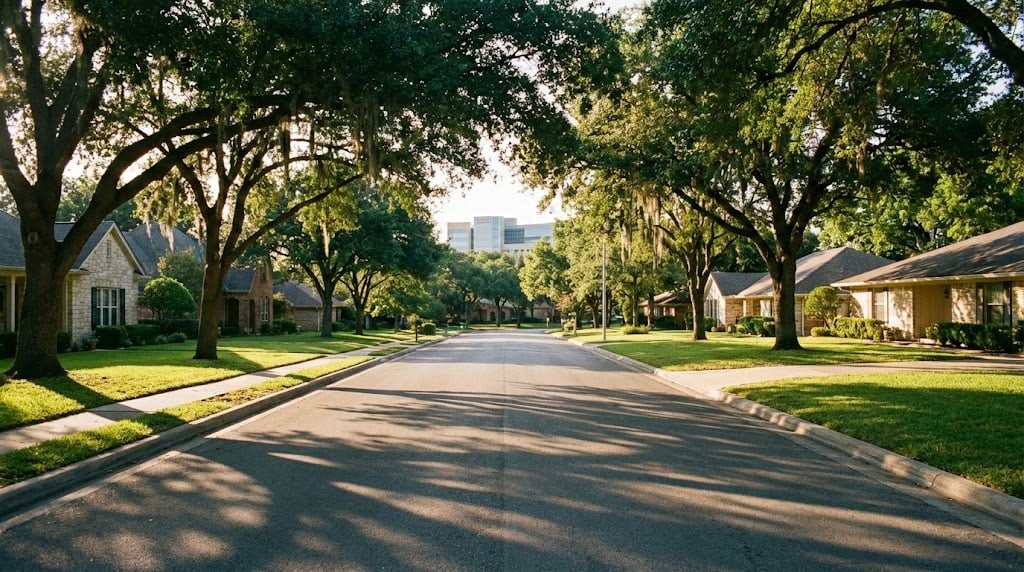
Read the matrix by your two jobs, not one
Each archetype below is scored on four objective axes — BSW drive-time tier, southbound/Austin access for a commuting or remote spouse, night-shift quiet, and price band. The dots are a relative scale (more filled = stronger on that axis). Use them to narrow, then we pull the exact streets and listings that clear your filter.
These are archetypes, described by drive-time tier, price band, and home type only — objective criteria, no steering. Where a tier depends on a specific route and hour, confirm it for your address. [VERIFY] specific minutes
Closest to BSW
- BSW drive tier
- Southbound / Austin access
- Night-shift quiet
- Price bandAt / above Temple median
Best for: a physician with daily on-site call where shaving the campus commute matters most, and a spouse who is remote or works in-town.
Best southbound / Austin commute
- BSW drive tier
- Southbound / Austin access
- Night-shift quiet
- Price bandAround Temple median
Best for: a spouse whose job (or hybrid days) pulls toward Round Rock / Austin, with a physician who can absorb a slightly longer campus drive.
Quietest for night shift
- BSW drive tier
- Southbound / Austin access
- Night-shift quiet
- Price bandAround Temple median
Best for: a physician on nights/rotating shifts who has to sleep during the day — low-traffic streets and setback matter more than a 2-minute commute edge.
Best value for a remote spouse
- BSW drive tier
- Southbound / Austin access
- Night-shift quiet
- Price bandBelow Temple median · more sq ft
Best for: a fully remote spouse who needs a dedicated home office — trade a couple of campus-commute minutes for more square footage and a lower price, since only one of you is driving.
The price anchors that frame the corridor
If the spouse’s job pulls west or north instead of into Temple, the corridor gives you options at different price points. Cite these as your baseline:
| Market | Median closed price | When the spouse’s job points here |
|---|---|---|
| Temple | $274,315 | Default — closest to the BSW campus; $157/sq ft, 72 days on market |
| Belton | $325,000 | Midpoint toward Killeen–Harker Heights; spouse job west of Temple |
| Harker Heights | $303,000 | Spouse job in the Killeen / Fort Hood corridor |
All three medians: june-18-mls-data.csv (closed thru 2026-06-16/17). Verify current figures before relying on them for an offer.
The two-commute insight most agents skip
When only one of you drives to a fixed location, “closest to BSW” is often the wrong optimization. A fully remote spouse changes the math entirely — you can trade campus-commute minutes for square footage, a quieter street, or a lower price, because the household only has one hard commute to protect. That’s why the matrix scores four archetypes instead of ranking one “best” neighborhood.
Go deeper on the campus-commute side with neighborhoods near BSW by commute, including the quiet, low-traffic streets that matter most when the physician works nights.


How do you sequence two careers and a home purchase?
Work backward from the physician’s start date. The spouse job search, childcare waitlists, and the home close all have lead times that overlap — so they have to run in parallel, not one after another. Here’s the honest 90/60/30-day sequence.

90 days out — set both careers in motion
This is the parallel-tracks window. Don’t wait to “settle in” before the spouse job search.
- Spouse applications go out to the local anchors and any remote roles; confirm whether a current role can convert to remote
- Childcare waitlist deposits — infant care especially fills early
- Mortgage pre-approval started (and confirm how the physician’s contract or a physician-loan option affects timing) [VERIFY] loan terms with a lender
60 days out — shortlist by the sum of two commutes
Now the housing decision narrows around what you’ve learned about both jobs.
- Match neighborhood archetype to your actual two commutes (or one commute + a home office)
- Tour or virtually tour the shortlist; pull days-on-market and pricing on real listings
- Confirm childcare proximity to both the campus and the spouse’s work/home office
30 days out — offer, close, and bridge the gap
Lock the home and have a plan for the job that hasn’t landed yet.
- Offer and close on the home that clears the dual-commute filter
- Finalize childcare enrollment from your waitlist position
- If the spouse role isn’t confirmed, activate the contingency — a remote bridge or short commute — rather than forcing a rushed local hire
The honest negative: the spouse role may land after the move
Plenty of dual-career relocations close the home before the spouse’s job is signed. That’s not a failure — it’s the norm. Build the move with a contingency: a remote bridge from a prior employer, freelance/contract income, or a short commute to a bigger metro for the first stretch. A home you can carry on one income during the gap beats a perfect two-job landing you bet on and didn’t get.

“Most BSW relocation advice solves the doctor’s move and stops there. The household decision — the other career, childcare, the second commute — is the part that actually decides where you buy.”
Here’s the pattern I see with dual-career BSW families. The physician’s relocation is handled by the residency or the employer, so the household relaxes — and then the trailing spouse hits a job market that’s real but narrower than where they came from. The ones who land well started the spouse search and the childcare waitlists at the same time they started looking at houses, not after.
The thing the data doesn’t show: when only one of you has a fixed commute, the “premium” of being closest to the BSW campus often isn’t worth it. If your partner is remote, you can buy more house, a quieter street for a night-shift sleeper, or a lower price six or seven minutes farther out — because the household only has one hard commute to protect. I’ve watched families overpay to be two minutes closer to a campus the spouse never drives to.
What I’ll actually do: map real neighborhoods to both of your commutes (or one commute plus a home office), tell you honestly where your spouse’s field does and doesn’t have a local market, and set up a buyer search that only surfaces homes clearing that filter. Start at the full Baylor Scott & White relocation hub →
Want it mapped to your household? Text Taylor directly → 254-718-4249
BSW dual-career relocation: frequently asked questions
Or comment / DM BSW on any of Taylor’s posts and he’ll send the BSW Temple Relocation Guide plus a neighborhood shortlist for both your commutes.