A practical first-home buying guide
First-Time Home Buyer
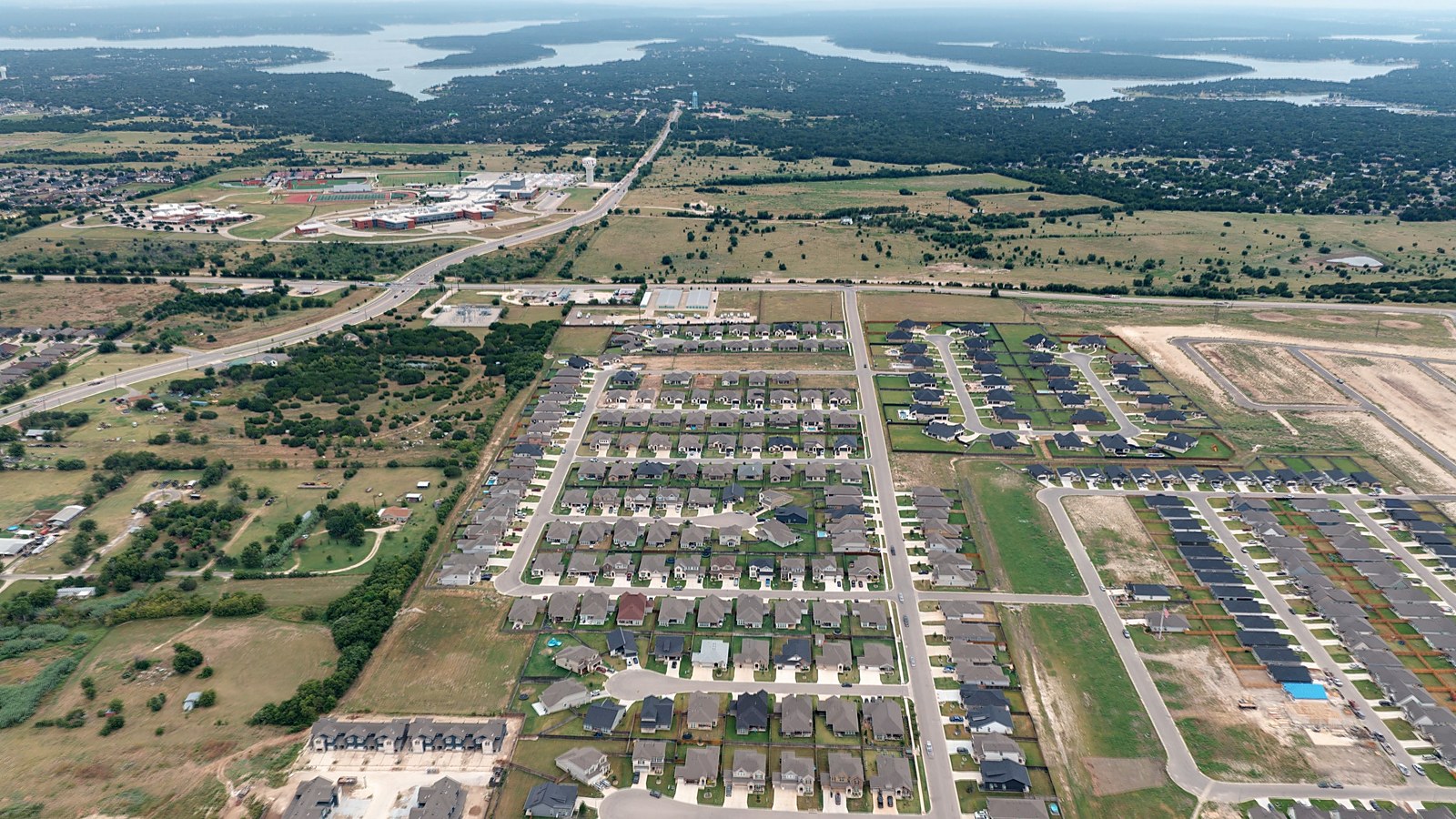
Mesa Ridge, Temple · Taylor Dasch’s aerial · Published August 2026
Buy when a particular home fits your monthly budget, cash reserves and likely time in the home. Owning gives you more control over the home and can build equity through principal repayment, but it also brings maintenance, transaction costs and price risk. Renting can preserve flexibility and leave more cash available for other priorities. Compare the full costs and your plans before deciding. Use the two-scenario cost worksheet, then check assistance terms and the contract and inspection questions.
- Some mortgage options allow less than 20% down. Down payment is only part of the cash needed to buy.
- A mortgage loan and down payment assistance are different obligations.
- A citywide median does not price the home you are considering.
Which down payment assistance routes should you check?
FHA, VA, USDA and conventional describe mortgage options. TSAHC, TDHCA and SETH administer programs that can pair mortgages with down payment or closing-cost assistance. Assistance may be a grant or a second loan with conditions. Ask for the exact product name and documents before counting it toward your cash to close.
| Operator | What the official source says | What to obtain from a participating lender |
|---|---|---|
| TSAHC | Homebuyer programs offer fixed-rate mortgages with assistance options. Its repayment FAQ distinguishes a grant from a three-year deferred forgivable second lien. | Which option is available for this loan? What rate, assistance amount, income calculation, education and occupancy requirements apply? |
| TDHCA | My First Texas Home has a first-time-buyer requirement with stated exceptions; My Choice Texas Home does not. The lender guide includes repayable and forgivable second-lien options. | Get the selected program, current county limits, borrower-income definition, term sheet and signed repayment conditions. |
| SETH | 5 Star Texas Advantage describes assistance as a second loan, with different forgiveness or deferred-repayment choices; no first-time-buyer requirement. | Confirm address eligibility, participating lender, current availability, rate and what sale or refinancing would trigger. |
Assistance sources checked October 21, 2026; source documents carry their own issue dates. Availability and the exact reserved loan combination still need lender confirmation.
Who counts as a first-time buyer?
The definition belongs to the selected program. TDHCA’s My First Texas Home matrix applies a three-year primary-residence ownership-and-occupancy test to borrowers and non-purchasing spouses, with qualified-veteran and targeted-area exceptions. My Choice Texas Home and SETH 5 Star do not require first-time status. Ask the lender to check the exact product, household and education requirements.
Read repayment conditions before planning a refinance
TSAHC’s consumer repayment FAQ has a six-month grant condition: the first mortgage must not be refinanced or otherwise paid off during that period. Its three-year forgivable second-lien terms can require full repayment during the term on sale, transfer, refinance, first-mortgage payoff, failure to occupy the home as a primary residence or another default. The grant is available with government loans; the conventional assistance route uses the forgivable second lien. Obtain the documents for your selected option; TSAHC terms do not automatically apply to TDHCA or SETH.
TDHCA’s lender guide, section 3.7, says its three-year option is forgiven only if the first mortgage is current and the home remains your primary residence at the third anniversary. Earlier sale, refinance, transfer or first-mortgage payoff can require repayment. Its 30-year deferred option is repayable. Check the current rate notice with the lender; not every loan and assistance combination is available.
What credit and occupation rules should you check?
TSAHC’s published credit guidance lists 620 for FHA, VA and USDA-RHS loans and 640 for conventional forgivable-second-lien assistance, with further underwriting rules. SETH 5 Star lists 640. These starting scores do not establish approval: income, debts, property, education, lender and product rules still apply.
TSAHC’s Homes for Texas Heroes uses specific service and occupation definitions. Hospital employment alone does not establish eligibility. Have the lender check your service, school-nurse role, qualifying faculty appointment or another listed category, and compare Home Sweet Texas if appropriate.
For any offer, ask: whose income counts; which year’s limits apply; whether the loan amount, purchase price or property type is capped; whether education is required; how funds are reserved; and what happens on sale, refinance, transfer or moving out. Do not treat a maximum advertised percentage as your approved amount.
Local assistance needs a separate availability check
Ask the city or program operator whether it currently funds purchase assistance for a new buyer, rather than repair or reconstruction for an existing owner. Confirm eligible addresses, income rules, funding and wait-list status in writing. Do not include an unreserved local award in your closing budget. This guide does not establish a currently funded Temple or Belton municipal purchase grant.
Start with a workable budget, then choose homes
Write down a comfortable monthly housing amount using your actual take-home income and other obligations. A lender’s approval amount is a borrowing limit, not a requirement to spend it. Keep money available for the move, repairs and an insurance deductible after closing.
- If your move date or income is uncertain: compare the cost of renewing or ending a lease with buying and potentially selling again soon.
- If you are ready to stay: test the payment with realistic taxes, insurance, maintenance and any HOA or district charges. Check a less favorable scenario, such as an insurance increase or unexpected repair.
- If cash is the constraint: ask a participating lender about assistance, and compare a loan without assistance so you can see any rate, fee or second-loan tradeoff.
Request comparable Loan Estimates from more than one lender using the same loan type, term, property and rate-lock assumptions. The CFPB’s Loan Estimate comparison guide explains how to compare expected terms and provide accurate property-tax and association-cost information.
For a broader household budget, use the Temple cost-of-living guide alongside the home-specific worksheet below. A loan payment is not your entire monthly budget.
What did Temple and Belton homes sell for in September 2026?
Screened CTXMLS Residential records with the MLS City field Temple show 116 observed September 1–30, 2026 closing events at a $267,000 median sale price, from an October 20, 2026 export. The Belton sample in that same export has 44 September closing events at a $328,400 median, also observed October 20, 2026. Prices are rounded to the nearest $100. These mixed-property samples are not first-time-buyer-only cohorts, current listings or a matched comparison of similar homes.
| MLS City field | Observed closings | Median sale price | Source observation |
|---|---|---|---|
| Temple | 116 | $267,000 | October 20, 2026 |
| Belton | 44 | $328,400 | October 20, 2026 |
Based on information from the Central Texas MLS for the period September 1, 2026 through September 30, 2026. Calculations and analysis by Taylor Dasch / EG Realty; not produced or verified by CTXMLS. These historical records do not identify homes available now.
Use this context to set a search range, then compare recent sales similar to each home in size, condition, location, lot and obligations. A gap between two cities’ medians does not isolate the value of a school district or establish a discount you can negotiate. A reduction from an original asking price is not the same as seller-paid closing costs.
Compare one home in each area using the same worksheet. Keep asking price, inspection needs, tax estimate, insurance quote, HOA documents and actual trip tests together. Start with the Temple market guide and Belton guide, then check the neighborhood guides for property questions.
How these historical samples were calculated
Source: Taylor-declared Temple/Belton Residential CTXMLS export archived October 20, 2026; the download date is an observation proxy, not a certified Matrix export timestamp. The declared scope is not certification of an exhaustive MLS universe. Filter: exact MLS City field, Closed status and closing date September 1–30, 2026. Events use normalized full street identity plus closing date as a proxy because these exports lack a reliable listing ID. Each sample has no duplicate event rows after that check; one Temple record without a usable street identity is excluded. Records require a closing price of at least $15,000 and no positive lease price. Median is the middle sorted price, or the average of the two middle prices for an even sample; displayed prices round to the nearest $100. These are observed MLS records, not an exhaustive municipal census or detached-only dataset. September closings are observed October 20, 2026; late reports and corrections may change counts and medians.
What sold within four Temple price bands?
These are groups within the same September closing sample, not current listings or matched-home valuations. Each shown metric has at least 10 usable records.
| Closed-price band | Observed closings | Median closed price | Median reported sq ft | Median year built |
|---|---|---|---|---|
| Under $225,000 | 31 | $190,000 | 1,355 | 1995 |
| $225,000–$249,999 | 19 | $241,400 | 1,524 | 2024 |
| $250,000–$274,999 | 14 | $264,800 | 1,723 | 2018 |
| $275,000–$300,000 inclusive | 15 | $285,000 | 1,967 | 2015 |
These four bands contain 79 of the 116 Temple events; 37 were above $300,000. All shown price, size and year metrics have the same usable count as their row. Reported size is the exported figure, not a measurement; year built does not establish condition or new-construction status. This export does not support ZIP or verified new-versus-resale comparisons. Small Belton price-band cells are omitted.
Compare the loan before adding assistance
A smaller down payment can preserve cash, but the complete loan cost still matters. Ask the lender to show principal and interest, any mortgage insurance or funding fees, financed fees, rate-lock terms and the payment after any temporary incentive ends.
| Loan route | Supported starting point | Questions for your actual file |
|---|---|---|
| FHA | HUD’s FHA overview describes a minimum down payment as low as 3.5% for qualifying borrowers. | What credit and underwriting conditions apply? Show upfront and ongoing mortgage insurance, the applicable loan limit and total cash required. |
| VA | VA purchase loans may allow eligible borrowers to buy without a down payment and do not require monthly mortgage insurance. | Confirm Certificate of Eligibility, entitlement, underwriting, appraisal, funding-fee exemption or cost, and closing costs. Zero down does not mean zero cash. |
| USDA Guaranteed | USDA’s Guaranteed program allows eligible borrowers and properties to receive 100% financing through approved lenders. | Use the property and income eligibility tools linked by USDA for the exact address and household; have an approved lender verify the result. Do not assume an entire town qualifies. |
| Conventional | Ask for a comparable conventional Loan Estimate alongside any government-backed option. | Confirm required down payment, mortgage insurance and its cancellation terms, rate, points and underwriting; compare total costs, not a single advertised number. |
USDA property geography and borrower income are separate tests. A postal city, subdivision name or rural appearance is not an eligibility decision. If the USDA map is unavailable, contact an approved lender through the official program page and obtain an address-specific review before relying on financing.
Compare the complete written offer
A builder credit or lower advertised starting rate can change cash needs, but it does not establish that a new home costs less than resale. Request the exact home, full price, included features, required lender or title provider, incentive deadline and expected completion date.
- Rate offer: is it fixed for the full term, a temporary buydown or an adjustable-rate mortgage? Obtain the APR, points, fees, qualification rules and payment after the introductory period.
- Credit: what can it pay, what limits apply, and does any unused amount disappear? Compare the same home without the offer and a loan from another lender.
- Price and options: put the lot premium, upgrades and included finishes in writing. Compare the contracted specification with what you saw in the model.
- Timing and condition: ask about completion, rate-lock extension costs, inspection access, written warranty coverage and how unresolved items will be documented.
The new-construction guide and Stylecraft guide provide builder-specific questions and dated source context. Obtain a current written offer for the exact home; a past promotion is not a standing rate quote.
Compare cash due now, the full monthly payment and costs over the time you realistically expect to keep the loan and home. Include any assistance payoff and selling costs. A lower rate is not automatically the better deal, and a hoped-for refinance should not be necessary to afford the payment.
What is the best new construction for first-time buyers in Temple?
Start with the home, full payment and written terms that fit your plans. First-time-buyer status does not set a price ceiling. These Temple options and nearby Belton comparisons are research routes, not a ranking of builders or a promise that a particular home is available.
| Builder and place | What the builder displayed | What to compare next |
|---|---|---|
| D.R. Horton · Temple | Pepper Creek Crossing from $209,235; Pecan Creek from $211,735. | Compare the exact available home, included work, completion and full loan offer. The D.R. Horton guide organizes the questions. |
| Stylecraft · Temple and Belton | The builder’s community list displayed South Pointe in Temple from $224,900 and The Ridge at Belle Meadows in Belton from $242,900. | Compare the plan, lot, included finishes and actual home price. Use the Stylecraft guide for the offer and property checks. |
| Centex · Belton | At Skyview, the community header displayed $262,990+. | A community starting price is not a completed-home quote. Confirm the lot, plan, options, build stage and total; see the Centex guide. |
These are dated advertisements, not closed-sale comparisons or quotes to you. Starting prices may exclude lot premiums and options and can change. Request the actual home’s price, tax and insurance estimates, HOA or district obligations, inspection rights and loan terms before comparing totals. Do not assume a builder incentive combines with assistance; have the participating lender confirm the specific combination in writing.
Build an address-specific ownership budget
Use the parcel’s records and written estimates rather than a single Temple or Belton tax percentage. The Texas Comptroller’s property-tax guide and homestead-exemption information explain the distinction between value, exemptions and taxes. An exemption reduces taxable value for the applicable unit; it does not make every taxing unit’s calculation identical. The Comptroller’s homestead guidance, checked October 21, 2026, states a $140,000 residence-homestead exemption for school-district taxes. This does not subtract $140,000 from the purchase price or every taxing unit’s value. Confirm your eligibility, exemptions and parcel with Bell CAD and the taxing authorities.
| Cost | Evidence to request | Question to resolve |
|---|---|---|
| Property taxes | Bell CAD parcel record, current taxing units and adopted rates; lender estimate. | Which exemptions actually apply to you? Is the estimate for the completed home rather than a prior vacant lot? |
| MUD, PID and HOA | District notices, assessment schedule, association resale documents, dues, transfer fees and any special assessments. | What is recurring, what is paid at closing, and which charges are already included in the tax estimate? Avoid counting them twice. |
| Insurance | Address-specific written quote and declarations showing coverage, exclusions, deductibles and roof settlement terms. | Can you fund the deductible and any excluded loss? Is separate flood coverage needed for your risk or lender requirement? |
| Utilities and upkeep | Available usage history, your service plans, inspection report and repair quotes. | What work is due soon? What reserve makes sense for this property rather than a citywide average? |
Translate the deductible into dollars
The Texas Department of Insurance’s deductible guidance explains percentage and dollar deductibles. Hypothetical example: a 2% deductible applied to $300,000 of dwelling coverage equals $6,000. The base is the applicable insured coverage amount, not automatically the purchase price, land value or repair bill. Check the policy and peril-specific terms.
Allow for escrow changes
A new home’s later tax valuation may include improvements that were absent from an earlier bill. Insurance premiums can also change. Ask the lender which values and premiums support the initial escrow estimate and how a later shortage would affect payments. Neither every new-build bill nor every payment necessarily doubles. Use the CFPB Loan Estimate explainer and TDI home-insurance guide to review the parts of the payment.
Choose by verified property needs and actual trips
A Temple or Belton mailing address does not establish a school district or campus assignment. Use the Temple-area school and address guide to reach official district tools, then confirm the exact address and relevant school year with the district. For 2026–27, ask about the assigned campuses, enrollment requirements and any published boundary changes. Ratings are one source to interpret, not proof of future appreciation.
Write down the places you actually need to reach, then test those routes at the times you would use them. Check entrances, parking and the last part of the trip. Compare the home’s layout, maintenance, street access, drainage and restrictions with your own requirements.
- At a resale home, request the available disclosure, inspection history and repair records; investigate what remains uncertain.
- At a new home, verify the lot, specification, drainage, inspection access and warranty documents for that specific contract.
- For any address, review the survey, title exceptions, flood information and insurance quote with the appropriate professionals.
Use Living in Belton and the neighborhood directory to organize further research. A neighborhood name is not a guarantee of a price range, school assignment, low risk or suitability for a particular household.
Compare two scenarios without assuming buying wins
Copy these tables into your notes or print the page. Use actual lease terms and written lender, insurer and property estimates. This is a worksheet, not an eligibility decision, mortgage quote or break-even calculator. No contact details are required.
Start with the numbers you know
Use this optional worksheet with a purchase price alone, or add your own monthly estimates. No contact details are required. This worksheet does not save or send your entries. Copy or print your work before leaving this page.
Enter dollars as 250000, $250,000 or 250,000.50. Leave unknown amounts blank. Enter 0 only when you have confirmed there is no separate cost.
Purchase price is unknown. You can still add monthly estimates below.
Add monthly costs (optional)
Use monthly amounts from written estimates. Enter principal and interest alone in the first row, then separate escrow costs below. Avoid entering a combined mortgage payment and counting taxes or insurance again. Divide annual estimates by 12 before entering them.
Monthly budget is unknown
Add any known costs, then choose Update worksheet. Blank rows stay unknown.
The nine monthly rows are not yet complete.
A completed worksheet totals only these rows and your assumptions. It does not verify the estimates, include every household expense or predict future costs.
Choose Update worksheet after changing an amount. Until then, the previous results are cleared.
Ready. All amounts are optional.
Down payment is only part of cash to close. Keep closing costs, prepaids, confirmed credits, deposits and retained reserves separate using the tables below. This worksheet is not a mortgage quote, approval or break-even calculation.
Ask Taylor to help compare homes. This opens the existing inquiry section; worksheet values are not sent with it.
| Monthly item | Scenario A: current rental | Scenario B: proposed purchase |
|---|---|---|
| Address and quote date | Write address / date | Write address / lender / date |
| Base payment | Rent: $_____ | Principal and interest: $_____ |
| Property taxes | Included in rent or separate charge: _____ | Full annual estimate ÷ 12: $_____ |
| Insurance | Renters insurance: $_____ | Home/flood insurance ÷ 12: $_____ |
| Mortgage insurance / other loan payment | Not applicable unless a separate obligation | Mortgage insurance + assistance-loan payment, if any: $_____ |
| HOA / district charges | Any separate rental charge: $_____ | Dues / assessments not already counted: $_____ |
| Utilities | Your responsibility: $_____ | Your responsibility: $_____ |
| Maintenance reserve | Your responsibility under lease: $_____ | Home-specific reserve: $_____ |
| Total monthly cash budget | Add the applicable rows: $_____ | Add the applicable rows: $_____ |
| What could change? | Renewal, moving or lease-exit costs | Insurance, taxes, repairs, rate changes or incentive expiry |
| Item | Amount or evidence |
|---|---|
| Down payment | Loan Estimate: $_____ |
| Closing costs, prepaids and initial escrow | Itemized estimate: $_____ |
| Less confirmed credits or assistance | Only approved amounts usable for these costs: −$_____ |
| Less deposit already paid | Verified deposit credit: −$_____ |
| Remaining cash at closing | Reconcile with lender/title Cash to Close: $_____ |
| Money already spent separately | Deposit, inspections, appraisal or other costs; note any closing credits to avoid double counting |
| Money retained after closing | Moving, repairs and emergency reserve: $_____ |
A fully hypothetical budget example
For illustration only, rental costs of $1,800 rent + $20 renters insurance + $180 utilities total $2,000 a month. A purchase scenario with $1,550 principal and interest + $450 taxes + $175 insurance + $125 mortgage insurance + $50 HOA + $200 maintenance reserve + $225 utilities totals $2,775 a month, or $775 more. These are invented inputs for arithmetic, not a Temple loan quote or expected property costs.
In a separate hypothetical cash calculation, $10,000 down payment + $6,500 closing costs + $2,500 prepaids/initial escrow − $4,000 confirmed credits/assistance − $2,000 deposit already paid = $13,000 remaining at closing. The deposit plus closing payment totals $15,000. A separate $6,000 reserve remains in the buyer’s account; inspections, moving and any other uncredited pre-closing costs still need their own budget. An actual Closing Disclosure may group items differently.
Neither monthly difference nor cash to close measures investment return. For a longer-term rent/buy comparison, also examine principal repayment, possible price changes, acquisition and sale costs, assistance repayment, maintenance, rent changes and what your cash could earn elsewhere. Test flat or falling home values as well as rising values. There is no promised break-even month.
Use the Loan Estimate explainer and Closing Disclosure explainer to reconcile your own figures, then ask the lender about any discrepancy.
Resolve the contract, inspection and appraisal questions
Understand your deadlines and representation
Before signing, identify who represents whom, what services and fees are agreed, and which contract and addenda apply. Have the applicable financing, inspection, termination, deposit, appraisal and closing deadlines explained. Do not assume every builder uses the same form or gives the same rights. TREC’s consumer guide distinguishes brokerage, lending, inspection and legal roles; complex contract questions may need a qualified attorney.
Keep the inspection separate from the appraisal
An appraisal addresses value for the lending process. Arrange a property inspection with an appropriately licensed professional, including for a completed new home. TREC’s inspection guidance explains the standard report and why an abbreviated walkthrough may not provide the same information. Ask about the scope, exclusions, specialty follow-up and time to review results before your contractual decision deadline.
Ask what a low appraisal would change
Have the lender show the loan amount and additional cash required if value is below price, using the loan’s applicable price/value basis and terms. Ask your agent or attorney which options the actual contract permits. A low appraisal does not by itself establish an automatic cash obligation or termination right.
Read the actual warranty
Get the builder or warranty provider’s coverage, exclusions, claim route, deadlines and transfer terms. Document unresolved items. A home’s age or a general “one-year warranty” phrase does not establish when every structural obligation ends.
Bring a property-question checklist
Price and specification; financing and appraisal terms; inspection access; written repair commitments; tax and insurance estimates; warranty contacts and deadlines. Copy these questions before your next tour.
Choose the home and payment you can sustain after closing, with room for the costs you cannot predict.
Work through your shortlist with Taylor
Bring the addresses, target monthly budget, timing and questions you want to resolve. Taylor can discuss the home search and property questions with you. Lenders determine loan eligibility and terms; insurers, districts and the relevant public offices confirm their own requirements.
Read about Taylor and his real-estate work, or use the inquiry form below to request a conversation.
What happens from preparation to closing?
- Set the budget: collect income, debt and cash information; choose a sustainable monthly amount and retained reserve.
- Compare financing: request lender estimates, assistance documents and a clear list of conditions. Obtain any required education before the program deadline.
- Tour and narrow the options: see homes, compare their layout, condition and everyday practicalities, then refine your must-haves and tradeoffs. What you notice in person can change the shortlist.
- Investigate the address: compare sales, parcel costs, insurance, restrictions, school assignment and actual routes.
- Review an offer: agree the price, credits, representation and contract deadlines. Schedule inspections and any specialty follow-up with enough time to act.
- Resolve closing conditions: track appraisal, underwriting, repairs, title and survey questions, insurance and the final walk-through.
- Reconcile and close: compare the Closing Disclosure with the latest Loan Estimate and resolve changes with the lender/title team. Verify payment instructions using a trusted independently obtained contact.
For loans covered by the standard Closing Disclosure requirement, the CFPB explains that you receive it at least three business days before closing. Review its explainer. Your overall timeline depends on the contract, financing, property and unresolved conditions; there is no universal 90-day schedule.
First-time home buyer questions
Do I need 20% down to buy my first home?
Not for every loan. HUD describes FHA down payments as low as 3.5% for qualifying borrowers, while eligible VA and USDA borrowers may have no-down-payment options. Each loan still has underwriting, property and cost requirements. Ask for total cash to close and ongoing mortgage insurance or fees, not just the down payment.
Is TSAHC a type of mortgage like FHA or VA?
No. TSAHC administers homebuyer programs that can pair a mortgage with assistance. FHA and VA describe different mortgage programs. Ask the participating lender to identify both the first mortgage and the separate grant or second-lien terms.
Does down payment assistance always get forgiven?
No. Assistance may be a grant, forgivable second loan or repayable loan. Sale, refinance, transfer or occupancy changes can trigger repayment under the selected documents. The operator’s maximum advertised amount is not your approval; compare the actual program terms and a loan without assistance.
Do all homes around Temple or Belton qualify for USDA?
No blanket city or subdivision conclusion is appropriate. USDA Guaranteed financing requires both eligible property geography and qualifying borrowers. Use the address and income tools linked from USDA’s official program page and have an approved lender confirm the actual file before relying on the loan.
What were Temple and Belton median sale prices in September 2026?
Screened CTXMLS Residential records with MLS City Temple had 116 observed September 1–30, 2026 closing events and a median sale price rounded to $267,000, observed in the October 20 export. The Belton sample in that same export had 44 September closing events and a median rounded to $328,400. Late reports or corrections can change these observations. These mixed-property samples are not current inventory, first-time-buyer-only cohorts or matched-home valuations.
Is a builder rate incentive better than a price reduction?
It depends on the exact offer, loan and expected time in the home and loan. Compare price, cash due, rate structure, fees, monthly cost after any introductory period, assistance payoff and eventual selling costs. Obtain dated written terms for the exact property; do not rely on a past promotion or a future refinance to make the payment affordable.
Why can a new home’s escrow payment change?
A later tax valuation may include completed improvements absent from an earlier bill, and insurance premiums can change. Ask which values and premiums the lender used and how a shortage would affect payments. This does not mean every new-build tax bill or payment doubles.
How do I calculate a percentage insurance deductible?
Use the coverage base specified by the policy. In a hypothetical example, a 2% deductible on $300,000 of dwelling coverage equals $6,000. Do not automatically use the home’s purchase price, land value or repair bill; confirm the applicable peril and policy terms with the insurer.
Does the worksheet say when buying breaks even?
No. It organizes monthly cash costs, cash due at closing and retained reserves using your actual estimates. A longer-term comparison also needs transaction and selling costs, maintenance, principal repayment, price and rent changes, assistance repayment and the alternative use of your cash. It does not guarantee appreciation or a break-even month.
What happens after I send the form?
The form requests a conversation with Taylor. On successful submission, you’ll see a saved-request receipt with a link to general buyer resources. This is not a custom loan quote, property analysis or automatic personalized report. Your lender and the relevant program operator determine financing and assistance eligibility.

Request a first-home buying conversation
Tell Taylor which properties, budget and timing you are comparing. Use the worksheet above to prepare questions for a manual conversation. Confirm loan terms with your lender and program operator.
Questions for your first-home search
Request a conversation with Taylor
Share your preferred monthly payment range and contact details. Use the ungated worksheet above to gather the property and lender questions you want to discuss.
Reviewed September 30, 2026. Historical sales and source observations are dated separately in the market section. Assistance and loan terms require confirmation for your actual application.