Temple new construction / Bell County incentive guide
Offer review: October 8, 2026 · MLS observed: October 8, 2026
Bell County builder incentives.
Compare the whole deal.
Compare advertised rates, closing-cost help and price reductions across Bell County. See the loan type, deadline and conditions before choosing a home.
4 builder advertisements in this dated review. Exact-home eligibility, available funds and lender approval still apply.
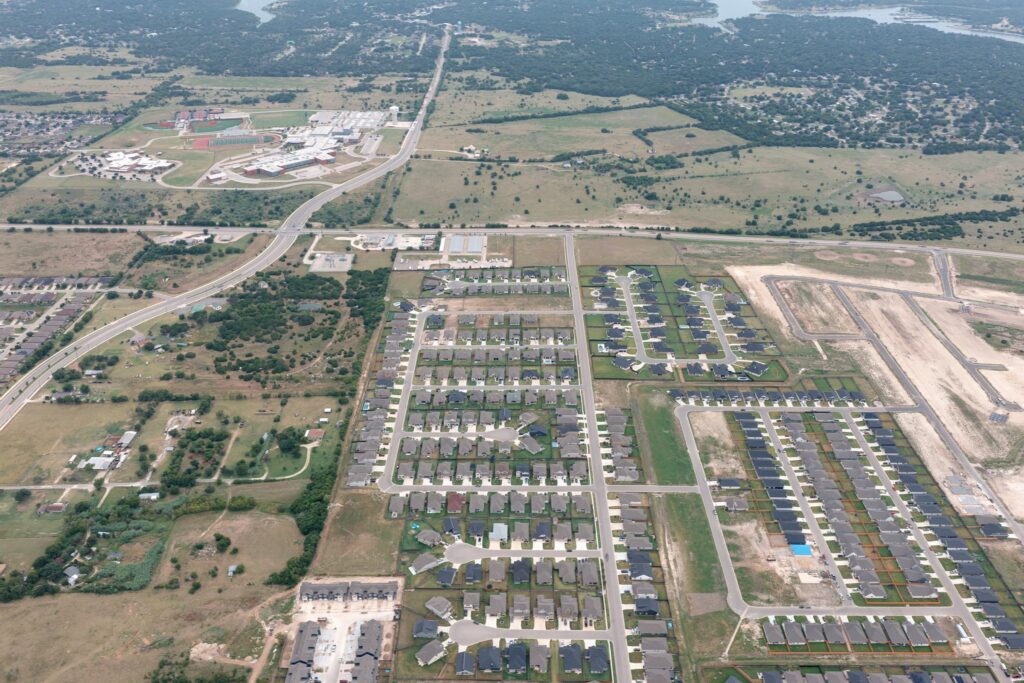
Taylor Dasch’s archive aerial; not the featured home.
Which builder incentive is actually better?
A lower advertised rate can have an adjustable term, extra points or an exclusive lender requirement. A credit helps with eligible upfront costs; a price reduction lowers the purchase price. Compare the same home, loan type, cash to close and payment after any introductory period. The comparisons below separate those choices.
What are local builders advertising?
Official sources reviewed October 8, 2026. Rates and APRs below are the builders’ examples, not a personalized loan quote. “Up to” is a maximum, and different promotions may be alternatives.
D.R. Horton
Temple · Killeen · Nolanville
5.697% APR
FHA · 30-year fixed
D.R. Horton’s October 8, 2026 advertisement for selected Temple, Killeen and Nolanville homes: The FHA example pairs a 4.99% fixed rate with 5.697% APR. A separate VA example pairs a 4.99% fixed rate with 5.142% APR. Compare the appropriate loan with an outside lender on the same home.
Loan conditions and eligibility
DHI Mortgage and primary residence required. The FHA example assumes 3.5% down; the VA example assumes zero down, subject to eligibility. Selected homes, credit approval and remaining rate-pool funds apply; points or additional costs may apply. The ad appears on Pepper Creek Crossing, Pecan Creek, Reynolds Crossing and Wildwood Estates pages. An individual home’s qualification and combination with other offers need confirmation.
This advertisement has reached its review or offer deadline. Ask for current written terms.
Stylecraft Builders
Northgate · Temple examples
6.879% APR
Initial 5/1 ARM · FHA APR example
Stylecraft’s October 8, 2026 advertisement, with Northgate homes in Temple on its qualifying list: Choose the initial ARM offer OR up to $20,000 Your Way on qualifying homes. The rate is fixed for five years; beginning in year six, the rate and payment can adjust annually. This is not a 30-year fixed-rate offer.
Loan conditions and eligibility
Kangaroo Home Lending; primary residence; minimum 680 credit score and maximum 50% debt-to-income ratio. FHA or VA loans are advertised, but the 6.879% APR is the FHA illustration. Thirty-year amortization; stated annual adjustment cap is one percentage point and lifetime cap five points. Rate-pool availability, lender approval and eligible credit use apply. Promotions are alternatives and cannot be assumed to combine. Builder’s current qualifying list includes 8203 and 8207 Barnett Drive.
This advertisement has reached its review or offer deadline. Ask for current written terms.
Flintrock Builders
Bell County · select quick move-ins
5.721% APR
Initial VA 5/1 ARM
Flintrock’s October 8, 2026 advertisement: A VA adjustable-rate example through Spark Mortgage. The initial rate is fixed for five years; rate and payment can change annually afterward. Ask for the maximum future payment and the exact home’s eligibility.
Loan conditions and eligibility
Primary residence, minimum 680 credit score and eligible VA borrower required. The builder’s example assumes zero down and a financed VA funding fee. Thirty-year term, one-year CMT index, 1.75-point margin, one-point annual adjustment cap and five-point lifetime cap. Finite funds; mention the lock program when applying. Not combinable; prior contracts, transfers and rewrites excluded. Disclosure heading is dated October 6 but its example footer retains September 3; reconfirm the written quote.
This advertisement has reached its review or offer deadline. Ask for current written terms.
Kiella Homebuilders
Temple / Belton builder · select communities
Closing costs and incentives
Kiella’s October 8, 2026 advertisement: Kiella advertises up to $20,000 toward costs and incentives OR a below-market fixed-rate offer without a numeric rate. The published amount is a ceiling, not an address-specific commitment.
Loan conditions and eligibility
The public page does not supply a current numeric rate, APR, lender requirement or contract/closing deadline for this offer. Ask for the qualifying address, actual amount, permitted use, lender conditions and stacking rules in writing.
This advertisement has reached its review or offer deadline. Ask for current written terms.
Lennar: the current offer needs review. Ask Taylor for address-specific written terms.
Each source link opens the builder’s own terms. Reconfirm the home, lender, lock period, contract date and closing deadline in writing. APR includes certain financing costs and is different from the interest rate.
More builder programs and coverage
Carothers Executive Homes: its community pages advertise up to $20,000 in savings on current inventory at Three Creeks, Belton, Turtle Creek, Troy and Wilma’s Way, Temple. The savings mechanism, address-specific amount, lender rules and deadline are not fully published. This is Carothers Executive Homes, a different company from Carothers Homes.
Kiella military program: active-duty, reserve and veteran buyers using a preferred lender are offered a $500 earnest-money requirement and an appliance package. Earnest money is a deposit, not a $500 discount. Package contents and combination with another promotion require builder confirmation.
KB Home: a national financing advertisement and Hidden Trails in Belton were found, but we have not established that a specific Bell County home qualifies. Ask for local written terms.
Omega, Saratoga and Tippit: our October 8 review did not establish a current, specific dollar or rate offer with sufficient local terms. Omega incentive information, Saratoga Killeen communities and Tippit communities remain starting points for an address-specific inquiry. This does not mean those builders offer no incentives.
Start with a few homes.
Open the city you need.
59 dated leads across 6 cities. The snapshot below needs a current availability check. These are research leads, not a ranking of the best deals. A price reduction already reflected in the asking price is not another credit to subtract.
Stale MLS snapshot. The source is older than 48 hours or its timestamp is unavailable. Prices and availability below are historical leads; refresh before relying on them.
Belton4 research leads
| Home / builder | Asking price | What MLS mentions | Compare |
|---|---|---|---|
| 1405 Fossil TrailBuilder not supplied in MLS · Hubbard Branch | $289,090 | Closing-cost or concession language; confirm the usable amount. Financing promotion; confirm loan type, APR and payment schedule. | Compare this home |
| 2528 Cowgirl TrailJubilee Homes · Hubbard Branch | $292,000Original asking price $295,000; reduction already in current price. | Preferred-lender condition mentioned. | Compare this home |
| 815 Liberty Park DriveNirmaan Builders LLC · Liberty Park | $334,000Original asking price $339,900; reduction already in current price. | Closing-cost or concession language; confirm the usable amount. Financing promotion; confirm loan type, APR and payment schedule. | Compare this home |
| 5232 Fenton LaneBuilder not supplied in MLS · Three Creeks Ph II | $335,000 | Closing-cost or concession language; confirm the usable amount. Financing promotion; confirm loan type, APR and payment schedule. | Compare this home |
Kempner1 research leads
| Home / builder | Asking price | What MLS mentions | Compare |
|---|---|---|---|
| 4238 Cold Springs RoadBuilder not supplied in MLS · Persimmon Spgs Ph Three Etj | $589,900 | Financing promotion; confirm loan type, APR and payment schedule. | Compare this home |
Killeen12 research leads
| Home / builder | Asking price | What MLS mentions | Compare |
|---|---|---|---|
| 1315 Lone Pine WayBFF Construction · DOGWOOD ADDITION | $199,990Original asking price $217,900; reduction already in current price. | Closing-cost or concession language; confirm the usable amount. Preferred-lender condition mentioned. | Compare this home |
| 1301 Lone Pine WayBFF Construction LLC · Dogwood | $204,990Original asking price $222,900; reduction already in current price. | Closing-cost or concession language; confirm the usable amount. Preferred-lender condition mentioned. | Compare this home |
| 1307 Lone Pine WayBFF Construction · DOGWOOD ADDITION | $214,000Original asking price $219,900; reduction already in current price. | Closing-cost or concession language; confirm the usable amount. Preferred-lender condition mentioned. | Compare this home |
| 1213 Lone Pine WayBFF Construction LLC · Dogwood | $224,900Original asking price $227,900; reduction already in current price. | Closing-cost or concession language; confirm the usable amount. Preferred-lender condition mentioned. | Compare this home |
| 1303 Lone Pine WayBFF Construction LLC · Dogwood | $224,990Original asking price $229,900; reduction already in current price. | Closing-cost or concession language; confirm the usable amount. Preferred-lender condition mentioned. | Compare this home |
| 1305 Lone Pine WayBFF Construction LLC · Dogwood | $224,990Original asking price $229,900; reduction already in current price. | Closing-cost or concession language; confirm the usable amount. Preferred-lender condition mentioned. | Compare this home |
| 3202 Salt Fork DriveVictory Homes · Goodnight Ranch Add | $249,900Original asking price $259,000; reduction already in current price. | Closing-cost or concession language; confirm the usable amount. Financing promotion; confirm loan type, APR and payment schedule. | Compare this home |
| 1804 Gigante DriveSummit Valor Homes · Lakeview Park Sub | $278,425 | Closing-cost or concession language; confirm the usable amount. | Compare this home |
| 9102 Chalk Maple DriveFlintrock Builders · Preserve at Thousand Oaks | $309,990Original asking price $315,649; reduction already in current price. | Preferred-lender condition mentioned. | Compare this home |
| 3106 Privet DriveBuilder not supplied in MLS · Goodnight Ranch | $325,265 | Closing-cost or concession language; confirm the usable amount. Financing promotion; confirm loan type, APR and payment schedule. | Compare this home |
| 9104 Chalk Maple DriveFlintrock Builders · Preserve at Thousand Oaks | $343,884 | Preferred-lender condition mentioned. | Compare this home |
| 9014 Chalk Maple DriveFlintrock Builders · Preserve at Thousand Oaks | $389,990 | Preferred-lender condition mentioned. | Compare this home |
Nolanville17 research leads
| Home / builder | Asking price | What MLS mentions | Compare |
|---|---|---|---|
| 433 Mustang LoopFlintrock Builders · Wildwood Estates | $270,140 | Preferred-lender condition mentioned. | Compare this home |
| 429 Mustang LoopFlintrock Builders · Wildwood Estates | $305,590 | Preferred-lender condition mentioned. | Compare this home |
| 421 Mustang LoopFlintrock Builders · Wildwood Estates | $353,190 | Preferred-lender condition mentioned. | Compare this home |
| 5059 Fence Line TrailFlintrock Builders · Bella Charca Phase 12 | $399,990Original asking price $460,090; reduction already in current price. | Preferred-lender condition mentioned. | Compare this home |
| 5071 Fence Line TrailFlintrock Builders · Bella Charca Phase 12 | $440,210 | Preferred-lender condition mentioned. | Compare this home |
| 1058 Winchester DriveA & G Residential LL · | $446,612 | Closing-cost or concession language; confirm the usable amount. Preferred-lender condition mentioned. | Compare this home |
| 4035 Prairie DriveFlintrock Builders · Bella Charca Phase 12 | $449,990Original asking price $462,155; reduction already in current price. | Preferred-lender condition mentioned. | Compare this home |
| 1007 Winchester DriveBuilder not supplied in MLS · Bella Charca Ph Ix | $459,718 | Closing-cost or concession language; confirm the usable amount. Preferred-lender condition mentioned. | Compare this home |
| 4042 Prairie DriveFlintrock Builders · Bella Charca Phase 12 | $464,990 | Preferred-lender condition mentioned. | Compare this home |
| 1015 Winchester DriveA&G Homes · Bella Charca Ph Ix | $479,650Original asking price $489,656; reduction already in current price. | Closing-cost or concession language; confirm the usable amount. Preferred-lender condition mentioned. | Compare this home |
| 4039 Prairie DriveFlintrock Builders · Bella Charca Phase 12 | $479,990 | Preferred-lender condition mentioned. | Compare this home |
| 5067 Fence Line TrailFlintrock Builders · Bella Charca Phase 12 | $487,965 | Preferred-lender condition mentioned. | Compare this home |
| 5026 Pheasant DriveFlintrock Builders · Bella Charca | $519,990Original asking price $528,558; reduction already in current price. | Preferred-lender condition mentioned. | Compare this home |
| 3070 Bella Vita DriveFlintrock Builders · Bella Charca | $531,589 | Preferred-lender condition mentioned. | Compare this home |
| 3006 Whitetail TrailManning Homes Inc · Bella Charca | $574,900Original asking price $599,900; reduction already in current price. | Financing promotion; confirm loan type, APR and payment schedule. Preferred-lender condition mentioned. | Compare this home |
| 3061 Bella Vita DriveFlintrock Builders · Bella Charca | $679,990Original asking price $684,990; reduction already in current price. | Preferred-lender condition mentioned. | Compare this home |
| 2021 Bluff DriveFlintrock Builders · Bella Charca | $699,990Original asking price $719,610; reduction already in current price. | Preferred-lender condition mentioned. | Compare this home |
Salado8 research leads
| Home / builder | Asking price | What MLS mentions | Compare |
|---|---|---|---|
| 1219 Haley LaneWhite River Homes · Drakes Landing | $459,900 | Preferred-lender condition mentioned. | Compare this home |
| 1201 Rylee LaneSandor Homes · Drakes Lndg Ph II | $469,000 | Closing-cost or concession language; confirm the usable amount. Financing promotion; confirm loan type, APR and payment schedule. | Compare this home |
| 1231 Haley LaneBuilder not supplied in MLS · Drakes Landing | $479,900 | Preferred-lender condition mentioned. | Compare this home |
| 1301 Haley LaneWhite River Homes · Drakes Lndg Ph II | $549,900 | Preferred-lender condition mentioned. | Compare this home |
| 6775 Kings Mill DriveFlintrock Builders · King Oaks | $599,990Original asking price $635,300; reduction already in current price. | Preferred-lender condition mentioned. | Compare this home |
| 6762 Kings Mill DriveFlintrock Builders · King Oaks | $731,604 | Preferred-lender condition mentioned. | Compare this home |
| 6774 Kings Mill DriveFlintrock Builders · King Oaks | $755,356Original asking price $757,520; reduction already in current price. | Preferred-lender condition mentioned. | Compare this home |
| 6768 Kings Mill DriveFlintrock Builders · King Oaks | $799,990Original asking price $804,705; reduction already in current price. | Preferred-lender condition mentioned. | Compare this home |
Temple17 research leads
| Home / builder | Asking price | What MLS mentions | Compare |
|---|---|---|---|
| 905 S 2nd StreetBuilder not supplied in MLS · | $190,000 | Financing promotion; confirm loan type, APR and payment schedule. | Compare this home |
| 907 S 2nd StreetBuilder not supplied in MLS · | $190,000 | Financing promotion; confirm loan type, APR and payment schedule. | Compare this home |
| 909 A S 2nd StreetBuilder not supplied in MLS · | $190,000 | Financing promotion; confirm loan type, APR and payment schedule. | Compare this home |
| 909 B S 2nd StreetBuilder not supplied in MLS · | $190,000 | Financing promotion; confirm loan type, APR and payment schedule. | Compare this home |
| 2932 Wolf Ridge LaneFlintrock Builders · Ridge at Knob Creek | $254,540 | Preferred-lender condition mentioned. | Compare this home |
| 1220 Peppermint RoadFlintrock Builders · Oak Ridge | $256,030 | Preferred-lender condition mentioned. | Compare this home |
| 1301 Peppermint RoadFlintrock Builders · Oak Ridge | $263,090 | Preferred-lender condition mentioned. | Compare this home |
| 1224 Peppermint RoadFlintrock Builders · Oak Ridge | $270,785 | Preferred-lender condition mentioned. | Compare this home |
| 2928 Wolf Ridge LaneFlintrock Builders · Ridge at Knob Creek | $278,115 | Preferred-lender condition mentioned. | Compare this home |
| 8725 Ponderosa Pine RoadFlintrock Builders · Mesa Ridge | $281,000Original asking price $284,052; reduction already in current price. | Preferred-lender condition mentioned. | Compare this home |
| 8707 Yellowcress DriveFlintrock Builders · Mesa Ridge | $290,095 | Preferred-lender condition mentioned. | Compare this home |
| 3111 Atascosa DriveBuilder not supplied in MLS · County View Add | $298,000 | Incentive language; request the exact terms. | Compare this home |
| 2936 Wolf Ridge LaneFlintrock Builders · Ridge at Knob Creek | $315,070 | Preferred-lender condition mentioned. | Compare this home |
| 8717 Ponderosa Pine RoadFlintrock Builders · Mesa Ridge | $315,390 | Preferred-lender condition mentioned. | Compare this home |
| 8709 Ponderosa Pine RoadFlintrock Builders · Mesa Ridge | $330,550 | Preferred-lender condition mentioned. | Compare this home |
| 5721 Sparrow CourtHodges Eagle Ridge Builders · Hartrick Crossing | $519,900 | Closing-cost or concession language; confirm the usable amount. | Compare this home |
| 7063 Troyan LnJDG Homes · The Landing at Heritage Oaks | $599,950Original asking price $640,550; reduction already in current price. | Closing-cost or concession language; confirm the usable amount. Preferred-lender condition mentioned. | Compare this home |
Source: CTXMLS public listing fields, observed October 8, 2026. Only the stated amounts are shown; unquantified incentive language is not converted into dollars. This is a selected new-construction incentive cohort, not all homes for sale. Status and terms can change after the observation. Read the selection method.
What does one offer look like
on an actual home?
A useful dossier starts with a specific address, then keeps the home facts, advertised financing and unanswered costs separate.
Exact-home sources checked October 13, 2026; unchanged facts and qualification link observed.
Stylecraft · Northgate · Temple
8203 Barnett Drive
$274,900
Stylecraft’s asking price for 8203 Barnett Drive in Temple was $274,900 on October 8, 2026. Listed on its qualifying-home page that day; availability and the final incentive still need reconfirmation.
- Bedrooms / bathrooms
- 4 / 2
- Living area
- 1,654 sq ft
- Stories / garage
- 1 story / 2 cars
- Plan name
- 1651
Builder-listed features include granite counters, a kitchen island, stainless-steel appliances, painted cabinets and a dual vanity. The plan name is not the home’s square footage.
Photos stay in the builder’s gallery so you can inspect the actual address and its current listing. We have not represented another home’s photograph as this one.
The offer to compare
4.49% initial rate · 6.879% APR
FHA example on a 5/1 ARM with 30-year amortization. The initial rate is fixed for five years; the rate and payment can adjust annually starting in year six. The alternative is up to $20,000 Your Way. They are not assumed to combine.
- Kangaroo Home Lending, primary residence and lender approval required.
- Minimum 680 credit score; maximum 50% debt-to-income ratio. The published APR is an FHA example, not a VA quote.
- Close by November 30, 2026; confirm available rate funds and this home’s final terms.
What the advertisement does not settle
- Your usable credit amount, points, lender fees and total cash to close.
- The completed-home property taxes, insurance, HOA dues and any MUD/PID charges.
- The maximum ARM payment, inspection findings, warranty coverage and closing schedule.
Ask for an outside-lender quote on the same home and loan. Compare the total costs before choosing the incentive.
The featured-home snapshot needs a fresh review. Ask Taylor for current availability and written terms.
What is a builder credit actually worth?
Try an illustrative comparison, then replace the sample rates with two written lender quotes. This assumes a 30-year fixed loan and the same down-payment percentage in each scenario.
Use the concession toward closing costs
Limited to the $8,000 sample eligible costs. The unused $2,000 is not cash back. P&I stays about $1,849/month.
Buy down the rate in your written quote
Illustration: $6,000 cost; about 64 months to recover that cost in P&I savings. Eligibility for any remaining credit must be confirmed.
Negotiate the same amount off the price
Illustration: price falls by $10,000; loan falls by $9,000 and down payment by $1,000. This alternative requires the builder’s agreement.
Principal and interest only. Taxes, insurance, mortgage insurance, VA funding fee, financed fees, HOA and MUD/PID costs are excluded. Credit use and contributions are limited by the loan program and actual eligible costs; no down-payment or cash-back benefit is assumed. The simple payback estimate ignores refinancing, selling, investment returns and different remaining loan balances. It is not an APR or a full cost comparison. ARM and temporary-buydown offers need a separate payment schedule.
Choose the tradeoff you can live with.
For upfront cash, compare the credit you can actually use. For a lower payment, compare the rate, the cost to obtain it and how long you expect to keep the loan. For an ARM, ask for the maximum possible payment after the fixed period. Don’t assume you can refinance before an increase.
A lower purchase price does not automatically lower your property-tax bill. Texas appraisal districts determine taxable value; taxes also depend on exemptions and local rates.
Guidance: CFPB on points and lender credits · compare Loan Estimates · Texas property valuation.
How quickly have builders’ homes sold?
Closed-sale history supplies context. It does not establish how much a builder will negotiate on the next home, and it is not a builder-quality ranking.
| Builder | Closed sales | Median MLS days on market | Median below original list |
|---|---|---|---|
| D.R. Horton | 374 | 36 days | 1.5% |
| Carothers Homes | 31 | 64 days | 0.0% |
| Flintrock Builders | 83 | 65 days | 2.0% |
| Centex | 30 | 65.5 days | 4.7% |
| Stylecraft | 173 | 77 days | 1.5% |
| Carothers Executive Homes | 66 | 145 days | 3.1% |
| Ashford Homes | 17 · small sample | 157 days | 2.6% |
The source contains 4,717 closed residential records. The selected cohort has 1,218 records explicitly marked Builder and built in 2025 or 2026; this table shows seven identified builder groups. Homes built before 2025 are excluded from this cohort. Of the 1,218 records, 245 have no builder name; they are not assigned to a builder in this table. Other unconfirmed builder labels are also excluded from the seven displayed groups. Days on market are listing-level; the price gap compares closed price with original list price and excludes loan incentives and upgrades. Builders’ locations, sizes and prices differ. Carothers Homes and Carothers Executive Homes remain separate companies.
What should you compare
before visiting the model home?
Keep the advertised savings beside the costs you will actually pay. A low headline rate cannot answer these questions for you.
The same loan, priced two ways
Ask the builder’s lender and an outside lender to quote the same loan type, term, down payment and lock period. Compare APR, points, lender fees, cash to close and payments after any introductory period.
The completed-home tax bill
A lot-only tax history can understate the cost of a completed new home. Check the parcel’s taxing entities, possible MUD/PID charges, HOA dues, insurance and exemptions for the exact address.
The home and the deadline
Confirm which address qualifies, what must happen by contract and closing dates, whether offers combine, and the inspection and warranty process. Ask how delays affect an expiring promotion.
Before registering or touring, ask Taylor about the builder’s agent-registration policy. If you already visited, say so; the policy varies by builder.
Send the home.
Compare the real terms.
Ask Taylor to help compare a specific builder offer with your other options. A link or address is enough to start. Just researching is a fine answer.
- Which offer applies to that home and your timeline.
- The lender requirements, usable credit and dates to confirm.
- The costs and questions to put beside the headline incentive.
Taylor Dasch · EG Realty · Temple, Texas
Tell Taylor whether you have already toured or registered with the builder.
Builder incentive questions
Are these builder incentives guaranteed for every home?
No. A builder-published promotion establishes what the builder advertised on the review date. Selected homes, lender rules, available funds, contract and closing dates, and borrower approval still apply. Ask for written terms for the exact address.
Is a lower mortgage rate better than a closing-cost credit?
It depends on the loan, the cost to obtain the rate, usable credit and how long you keep the loan. Compare written Loan Estimates on the same home, loan type, term and down payment. An adjustable or temporary introductory rate is different from a fixed rate for the entire term.
Can builder incentives pay my down payment?
Do not assume they can. Seller contributions are limited by the loan program and eligible costs. A closing-cost credit is not cash back, and unused credit may be lost. Ask the lender to confirm the permitted use before choosing the offer.
Can I combine a price reduction, lender credit and rate offer?
Only if the builder and lender confirm the combination in writing. Some promotions are alternatives. A price reduction already reflected in the asking price is not a second credit to subtract.
Does a lower purchase price automatically reduce Texas property taxes?
No. Appraisal districts determine taxable value, and taxes depend on the value, exemptions and local rates. For new construction, check the completed-home estimate rather than relying on a lot-only tax history.
How current is the MLS incentive board?
The board shows its source observation date. MLS observations older than 48 hours are labeled stale, and a page rebuild does not make them current. Listing remarks identify research leads; they do not prove a home or borrower qualifies for a promotion.
Should I talk to an agent before touring a builder model home?
Ask about the builder’s agent-registration policy before visiting or registering online. Policies vary. Tell Taylor if you already visited, whether you were represented, and whether you have a scheduled appointment.
What the dates and labels mean
Builder-published offer
The builder’s own page was read on the displayed review date. Its rate, APR, offer type and dates are retained together. This confirms the public advertisement, not the exact home’s eligibility, available rate funds or your approval. “No published deadline” means the source omits one, not that the offer lasts forever.
MLS-detected lead
The board uses active residential records in a dated Bell County new-construction cohort. Listings explicitly marked resale are excluded. Public remarks can identify a concession or financing program without giving its amount. A repeated keyword, long days on market or previous price cut does not prove that incentives combine or that a seller will accept less.
Review and freshness
Builder sources are checked by the existing daily workflow. Changed terms wait for review before the public offer copy can be reused. The editorial offer review expires after seven days; advertised deadlines can expire sooner. MLS observations older than 48 hours are labeled stale. A new page build never creates a new source observation. The weekly review checks the offers, the featured home and any unresolved source failures.
Page content reviewed October 8, 2026. Offer review: October 8, 2026. MLS observed: October 8, 2026. Availability and terms can change at any time. Confirm the home and lender’s written terms before signing or locking a rate.