


Temple TX Out-of-State Investing (2026): The Local Investor Case for Cash Flow, Mid-Term Rentals, and Builder Incentives
Written by Taylor Dasch (Realtor, EG Realty) — hyper-local intelligence for out-of-state investors targeting mid-term rentals, long-term rentals, and new-build incentives in Bell County.
Temple, TX is a rare 2026 “sweet spot” market for investors because you can still buy around a $255k median price point (vs. $550k+ in Austin) while underwriting realistic 6–8% cap rates. With recession-resistant demand from Baylor Scott & White and Fort Cavazos plus 92%+ occupancy across Bell County, you get a compelling blend of cash flow and appreciation potential.
Market Snapshot
Temple Median
$255k
Lower entry vs Austin; investors often buy below median.
Austin Median
$550k+
Growth influence without Austin pricing.
Avg Cap Rates
6–8%
Value-add can push higher with the right buy/rehab.
Occupancy
92%+
Bell County stays resilient.
Distance to Austin
~60 mi
I-35 corridor advantage.
Distance to Waco
~30–40 mi
Regional access + tenant mobility.
Property Taxes
~2.2%
Area-dependent; underwriting matters.
No State Income Tax
TX
More cash flow stays with you.
I’m Taylor Dasch with EG Realty, a local Temple Realtor who works with out-of-state investors every week. This is Part 1 of my 5-part guide to investing in Temple, Texas—built for people who want clean underwriting, reliable tenant demand, and a strategy that actually performs. BUILD | SERVE | GROW is how I show up: build the plan, serve you with real numbers, and grow your portfolio with repeatable execution.
Temple’s edge in 2026 is simple: you get big-city growth gravity (Austin + Waco) with a price point that still supports cash flow. Add recession-proof demand (healthcare + military) and you’ve got a market where both rent stability and resale confidence are real.
The Location Advantage: Proximity to Austin & Waco
Temple sits in a geographic “sweet spot” on the I-35 corridor—close enough to benefit from metro expansion, but priced like a secondary market where the math still works. You’re not buying at Austin prices, but you’re absolutely influenced by Austin growth over time.
- ~60 miles to Austin — growth gravity without the $550k+ median pricing.
- ~30–40 miles to Waco — regional access and commuting flexibility.
- No state income tax — a direct tailwind for after-tax cash flow.
- Property taxes ~2.2% in Temple (varies by pocket; we underwrite this precisely).
- Bell County continues to rank among Texas’ faster-growing areas—migration + job engines keep demand moving.
Recession-Proof Economic Drivers (Highlight Baylor Scott & White and Fort Cavazos)
Most investors underestimate Temple because it’s not a “headline city.” That’s the opportunity. Tenant demand here is anchored by two institutions that don’t disappear in a downturn: Baylor Scott & White and Fort Cavazos.
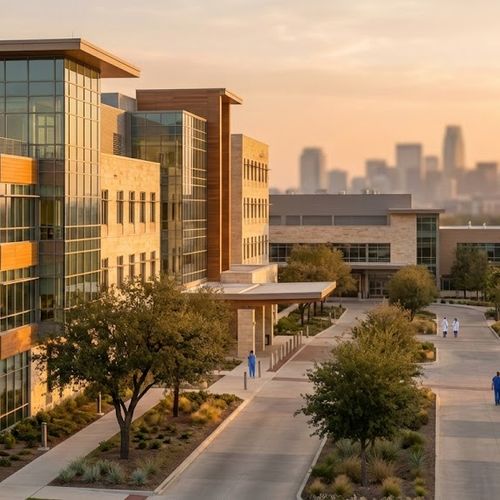
- Baylor Scott & White (Temple): 11th largest hospital in Texas, 8,000+ employees, teaching hospital — a core driver for mid-term rentals (travel nurses + medical professionals).
- Fort Cavazos (formerly Fort Hood): ~40 minutes away with 45,000+ soldiers & contractors — consistent inbound demand for quality housing.
- Many military families choose Temple over closer options like Killeen or Harker Heights for quality-of-life, schools, and neighborhood feel.
These two anchors create a constant flow of tenants across healthcare and military—two of the most durable industries you can underwrite. That’s why Temple can hold occupancy and rent velocity even when other markets get choppy.
The Math: Rent, Cap Rates, and The 1% Rule
Let’s get into the numbers the way investors actually evaluate a market: rent ranges, average cap rates, and whether the 1% rule is attainable.
- 3 bed / 2 bath rents: typically $1,500–$1,750/month (depends on size, age, and finish level).
- Average cap rates: roughly 6–8% across Temple.
- Occupancy: 92%+ across Bell County.
- My target (value-add): often 12–18% by buying older properties right and forcing appreciation.
Here’s the quick screening method I use: compare rent to purchase price and see how close you are to the 1% rule. In many Texas metros, you’re lucky to hit a 5% cap rate. In Temple, the 1% rule can still be attainable—especially in value-add pockets.
Newer homes often trade lower cap rates for lower maintenance and smoother remote execution. Older homes can produce higher yields, but you need disciplined rehab scopes and neighborhood selection. Temple has lanes for both styles.
New Construction vs. Value-Add Opportunities
One reason Temple is underrated: it supports multiple strategies without forcing you into a single “one-size-fits-all” play. In 2026, you can choose between new-build stability and value-add cash flow—and both can pencil depending on your goals.
- New construction: lower maintenance, cleaner execution, often ideal for remote investors who prioritize predictability.
- Value-add: higher cash flow potential by buying older homes below median and improving the asset/operations.
- Builder incentives: some builders are offering attractive financing—especially Omega Builders and Stylecraft—often quoted in the 4–5% interest rate range (programs vary by community and lender).
- Temple remains underbuilt relative to growth—more people moving in than leaving is a long-run tailwind for appreciation.
If you want a tax-focused plan with a cleaner asset, new builds can make sense. If you want maximum yield, we’ll look at older neighborhoods where the buy is right and the upside is created. Either way, the “window” where cash flow and builder incentives overlap isn’t open forever.
Get My Custom Investor Guide (Temple TX) — and Build Your Plan with Local Data
If you’re serious about Temple TX out-of-state investing, don’t guess from 1,000 miles away. I’ll send you my Custom Investor Guide and (if you share your goals) tailor it to your exact strategy: mid-term rentals, long-term rentals, new builds, or value-add cash flow.
This post is Part 1 of a 5-part series. Part 2 covers my exact remote buying process for out-of-state investors (from sourcing and underwriting to inspections and closing without getting on a plane). Builder incentives and rates vary by lender, credit, and community; I’ll verify current programs for your target neighborhoods.
Check out this article next
Match Day 2026 Housing Timeline for BSW Temple Residents (First 72 Hours)
BSW Temple Housing Timeline (Match Day 2026 → Move-In)Match Day 2026 is Friday, March 20, 2026, and applicants get their results at 12:00 p.m. ET.If…
Read Article